
Grade 23 titanium plate is Ti-6Al-4V ELI, but “ELI” does not finish the purchase specification. Interstitial limits, governing flat-product or medical-material specification, melt pedigree, plate condition, microstructure, ultrasonic scope and supplier qualification still need written control. Five company-owned pages met the source rule; none can turn catalogue wording alone into implant approval.
How the five company sources were selected
We froze the query Grade 23 Ti-6Al-4V ELI titanium plate supplier ASTM B265 F136 on 1 September 2026. Eligible company-owned sources had to identify Grade 23/ELI plate or sheet and expose at least one specification, chemistry, dimension, condition, test or document field. Beiyu, marketplaces, directories, third-party lists and generic Ti-6Al-4V pages without an ELI route were excluded. Discovery order is not a quality or regulatory ranking.
A public page can identify a likely supply route. It cannot prove allocated stock, a current program approval, final schedule, lot compliance or suitability of material not yet produced or assigned. Those points remain dated quotation fields.
Company pages that met the rule
| Company source | Page role | Visible fields | RFQ check |
|---|---|---|---|
| Chalco Titanium | Grade 23 plate page | B265/F136 references, dimensions, condition and certificate route | Choose the governing material scope and require actual heat chemistry and process records |
| Continental Steel & Tube | Grade 23 alloy page | ELI identity, chemistry/mechanical context and mill-product availability | Confirm the offered plate specification, mill, thickness, condition and release package |
| STRX Titanium | Grade 23 plate product page | ELI plate route, sizes, surfaces and order context | Return exact specification, heat treatment, melt source, tolerance and inspection |
| XTL Titanium | Grade 23 sheet/plate page | ELI flat product and stated medical-material application route | Treat application language as a lead; require material and quality-system evidence separately |
| FRL Metal | Ti-6Al-4V ELI plate page | Grade, dimensional range, standards and supply fields | Reconcile sheet/plate, B265/F136 scope, condition, interstitials and records |
Some pages describe medical applications while others describe a material grade across several forms. Neither is equivalent to a validated finished device. Material compliance, supplier quality-system approval, special-process validation, biocompatibility assessment, device design controls and regulatory clearance remain separate evidence chains owned by the buyer’s program.
Keep ELI chemistry and medical approval separate
| Decision | Choices visible in the source set | Required written return |
|---|---|---|
| Material scope | ASTM B265 Grade 23 plate, ASTM F136 material, AMS route or customer specification | One ordered scope/revision and a written conflict/precedence rule |
| ELI chemistry | Heat and product analysis for oxygen, nitrogen, hydrogen, iron and other limits | Actual values, test method, heat identity and permitted retest rule |
| Melt/microstructure | Melt sequence, billet/rolling route, heat treatment, alpha case and microstructure | Process route plus required macro/micro acceptance and records |
| Plate geometry | Thickness, width, length, flatness, surface, edge and machining allowance | Finished dimensions/tolerance, inspection map and usable envelope |
| Program approval | Material conformance versus approved source/process and finished-device validation | Separate evidence list; no approval inferred from catalogue wording |
The central risk is collapsing several control layers into the phrase “medical Grade 23.” First establish the material standard and actual interstitial results. Then establish the named melt source, rolling and heat-treatment route, microstructure and surface condition. Finally establish whether the buyer’s quality system requires an approved mill, distributor, special processor or test laboratory. If plate will become an implant or other regulated component, the buyer must define downstream cleaning, machining, surface treatment, validation, traceability and change-control requirements. A supplier’s reference to F136 or medical use is useful for discovery but is not permission to skip qualification. Record every cut piece back to heat and parent plate, and define whether remnant substitution is allowed.
For a regulated component blank, construct a genealogy from sponge or approved melt source through ingot, billet, rolling slab, parent plate, cut blank and finished device lot. Define quarantine, nonconformance disposition, record-retention period and advance notification for melt-site, furnace, rolling-mill or test-laboratory changes. Surface contamination controls may require dedicated handling, verified cleaning agents and restrictions on iron-contact tooling. A coupon taken from a convenient remnant may not represent the ordered orientation or thermal history, so locate witness material and destructive tests in the quality plan. These controls belong to the device manufacturer’s risk file and supplier agreement, not to a generic claim that the alloy is biocompatible.
A conflict between visible page fields is a verification prompt, not proof that a company cannot supply the item. Preserve the difference, request a clean technical return and let the purchase order control final identity, geometry, responsibility and acceptance.
Send one controlled RFQ
| RFQ line | Buyer input | Supplier return |
|---|---|---|
| Identity | Grade 23 / Ti-6Al-4V ELI, governing specification/revision and application | Offered scope, deviations and standards precedence |
| Chemistry/source | Interstitial limits, melt sequence, approved mill/process and heat trace | Original heat data, source evidence and traceability route |
| Geometry/condition | Plate dimensions, tolerances, condition, surface, edge and allowance | Signed dimensional/condition return and cut plan |
| Inspection | Mechanical tests, product analysis, UT, macro/microstructure and surface | ITP, sampling, methods, acceptance and lot reports |
| Quality boundary | Material certificate, QMS/program approvals, change notification and record retention | Distinct evidence for material, source, processor and finished application |
| Commercial | Quantity, first article/sample, packing, date and destination | MOQ, current schedule, validity, exclusions and preservation |
Remove any source that cannot return the exact material, deliverable, finished geometry and acceptance evidence. Compare price, schedule and terms only after technical lines, responsibility boundary and document scope are aligned.
Where Beiyu fits
Beiyu is outside the five-company set. Its Grade 23 plate route asks for the governing B265/F136/AMS/customer specification and revision, actual ELI interstitial limits, melt/source restrictions, plate dimensions and condition, microstructure/UT/surface plan, traceability, program approval evidence if required, quantity, packing and destination. Beiyu material availability is not presented as a medical-device approval.
The fields in this section describe only Beiyu’s published enquiry route. They do not score the companies above and do not transfer to another company’s catalogue.
Related Beiyu pages
- Grade 23 titanium plate
- Titanium plate supplier pages compared
- Titanium plate grade selection guide
- How to compare titanium quotations
Published by Beiyu Titanium. Beiyu is outside the five-company set. The sequence is a dated discovery snapshot after the stated exclusions, not a rating or endorsement.
Related supplier lists and supply ranges
- titanium sheet and plate supply range
- Alloy 625 Plate Suppliers
- Grade 12 Titanium Plate Suppliers
- Grade 5 Titanium Plate Suppliers
- Inconel 600 Plate Suppliers
- Nickel 201 Plate Suppliers
- Sintered Porous Titanium Plate Suppliers
- all supplier lists by product family
Specification detail with sources
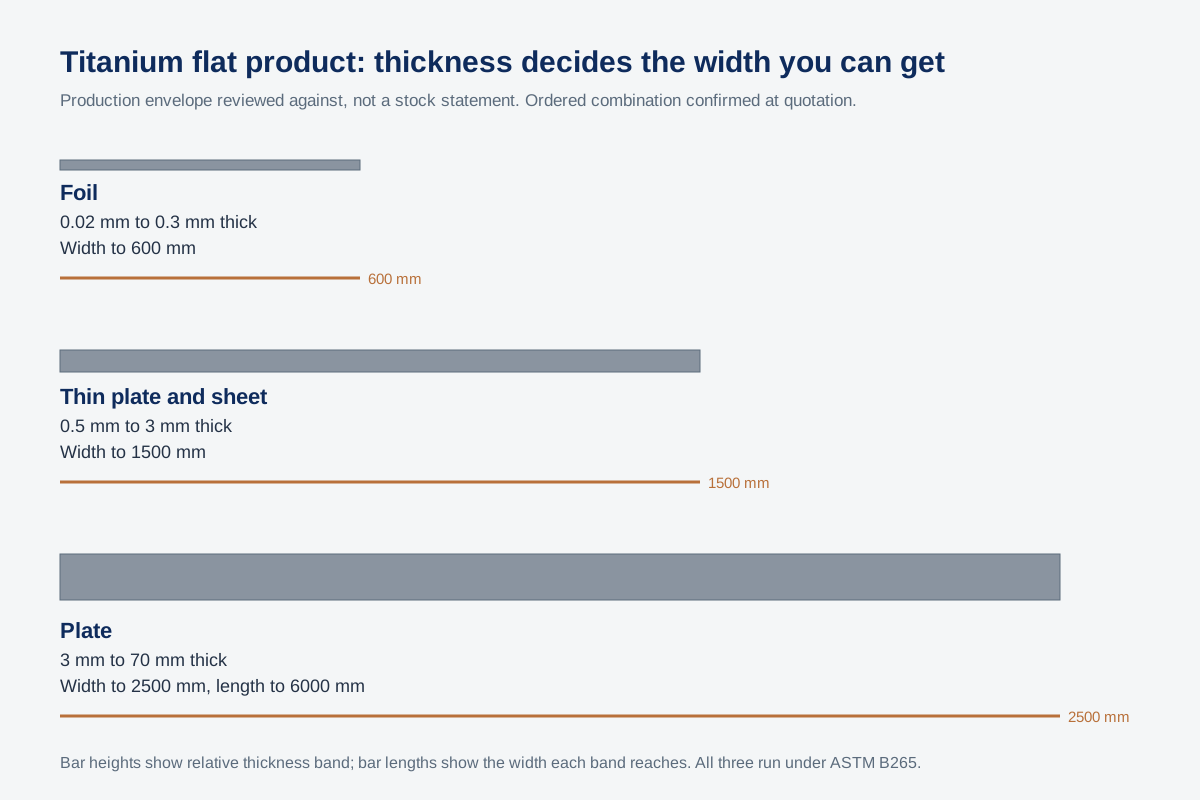
Beiyu Titanium publishes this list and is not part of the comparison above. For readers who want the publisher’s own figures on the same basis they would ask of any supplier on this page, the material is specified to ASTM B265, and each order carries an EN 10204 type 3.1 certificate with heat and pour numbers by order scope.
Beiyu supplies thin plate and sheet 0.5 to 3 mm thick in widths to 1500 mm, and heavy plate 3 to 70 mm thick in widths to 2500 mm, both in lengths to 6000 mm, with surface condition stated on the order.
These are Beiyu published supply figures and inspection parameters, not limits taken from the standard; limit values belong to ASTM B265 and are confirmed against the exact edition named on the purchase order. Certification is stated as a production capability, and no stock position, delivery time or price is implied by any figure on this page.