
Grade 7 titanium sheet adds palladium to a Grade 2-type base for demanding corrosion service, but the alloy name is not a design envelope. A useful purchase must connect UNS R52400 heat identity to ASTM B265 sheet geometry, the chosen process environment, forming and welding plans, surface condition and lot documents. Five company-owned sources met the rule; their visible ranges become comparable only after the corrosion and fabrication boundaries are written down.
How the five company sources were selected
We froze the query Grade 7 titanium sheet supplier ASTM B265 UNS R52400 on 1 September 2026. Eligible company-owned sources had to identify Grade 7 sheet or flat product and expose the grade plus a standard, product form, dimension, production, test or traceability field. Beiyu, excluded-geography companies, marketplaces, directories, third-party lists and pages that mentioned Grade 7 only as a generic alloy were excluded. The source sequence records discovery after exclusions and does not rank quality or corrosion performance.
A public page can identify a likely supply route. It cannot prove allocated stock, current program approval, final schedule, lot compliance or suitability of material not yet produced or assigned. Those points remain dated quotation fields.
Company pages that met the rule
| Company source | Page role | Visible fields | RFQ check |
|---|---|---|---|
| ATI | Producer Grade 7 page | UNS R52400, palladium/interstitial chemistry, B265/SB-265 and sheet/plate mechanical fields | Return the exact product form, heat values, size, condition and current producer release |
| Titanium Industries | Titanium sheet range page | Grade 7 sheet, B265/SB-265 and EN 10204 3.1 route | Confirm parent mill/heat, stock size, cut service, specification edition and finished tolerance |
| Daxun | Grade 7 sheet/plate page | R52400, rolling routes, size, surface and B265/SB-265 fields | Separate sheet from plate and bind rolling, anneal, surface and inspection to the offer |
| Lihua Group | Grade 7 sheet page | B265 label, sheet/plate dimensions, surface and commercial order fields | Request actual Pd heat result, finished geometry, lot plan and certificate package |
| Nippon Steel | Company titanium flat-product catalogue | Grade 7 under B265/SB-265 plus sheet/coil production and size context | Verify current orderability, mill location, size window, surface and project-specific controls |
The sources do not carry equal responsibilities. A producing mill can control melting and rolling, while a distributor may control only stock segregation and cutting. The buyer should request a responsibility map that identifies the melt source, rolling mill, heat-treatment location, testing laboratory and cutting processor. Each cut blank needs a traceable path back to the parent heat and sheet, including remnants if they are allowed.
Keep palladium chemistry, sheet form and service design linked
| Decision | Choices visible in the source set | Required written return |
|---|---|---|
| Alloy identity | Grade 7 / UNS R52400 with the ordered palladium and interstitial limits | Original heat/product analysis and traceability through all cuts |
| Flat-product route | B265/SB-265 sheet, plate or strip; thickness boundary and edition | One product definition, revision and tolerance table per line |
| Corrosion basis | Media constituents, concentration, temperature, aeration, velocity, deposits and crevices | Supplier exceptions plus buyer/design-authority acceptance |
| Fabrication | Rolling direction, bend/forming path, weld plan, filler, shielding and post-fabrication cleaning | Process assumptions, sample/coupon needs and contamination controls |
| Release | Chemistry, mechanical orientation, dimensions, surface, optional corrosion or special tests | Methods, sampling, acceptance, lot map and actual reports |
Palladium-bearing chemistry is the first identity check, not the last engineering decision. Ask for actual heat values and make sure every cut piece retains that heat link. Then define the process environment with enough detail for the buyer’s corrosion authority to review it. A supplier’s phrase such as “for reducing acid service” cannot cover unknown concentration, temperature, oxidants, impurities, flow or crevice conditions. Sheet form also matters: a thin cold-rolled sheet intended for lining has different flatness, handling and weld-sequence risks from a heavy plate used for a structural component. Where the page combines sheet and plate, require the quotation to return exactly one form and its governing tolerance.
For a vessel lining, specify the substrate, attachment layout, venting, overlap or butt-joint design, weld sequence and access for leak testing. Thin Grade 7 sheet can arrive chemically correct yet become unsuitable after buckling, edge damage, iron contamination or poor shielding during fabrication. Define surface preparation on both the process and backing sides, permissible grinding media, gas coverage and heat-tint acceptance. If the lining is explosively bonded or mechanically attached, name the cladding process and interface tests separately from B265 mill acceptance. Final corrosion suitability remains a system decision involving welds, crevices, gaskets, stagnant zones and cleaning chemistry, not a property that the material certificate settles alone.
An electrolyzer or chlor-alkali cell adds electrical details that a generic corrosion table misses. Identify anode and cathode zones, current density, busbar interfaces, contact pressure, coating-free masks, gasket compression and stray-current paths. Map wet-dry transition lines and hydrogen-evolution regions, then decide whether hydrogen uptake monitoring or a coupon program belongs in commissioning. Hole patterns, hanger tabs and formed channels should be inspected against a cell assembly datum, not only flat-sheet dimensions. Keep coating supplier, electrical continuity, leak test and startup electrolyte controls outside the mill’s B265 certificate so that responsibility remains visible.
A conflict between visible page fields is a verification prompt, not proof that a company cannot supply the item. Preserve the difference, request a clean technical return and let the purchase order control final identity, geometry, responsibility and acceptance.
Send one controlled RFQ
| RFQ line | Buyer input | Supplier return |
|---|---|---|
| Service | Full stream composition/range, temperature, pressure, flow, upset and crevice geometry | Compatibility observations, exceptions and design-responsibility boundary |
| Identity | Grade 7/R52400, B265/SB-265 revision and sheet definition | Exact offered standard, source, heat chemistry and deviations |
| Geometry | Thickness, width, length, flatness, edge, grain direction and quantity | Finished dimensions, tolerance source, cut plan and yield |
| Fabrication | Forming, joining, lining method, surface, cleaning and contamination limits | Process assumptions, capability limits and qualification records |
| Inspection/documents | MTC, product analysis, mechanical, dimensional, surface and special tests | ITP, actual reports and heat-to-piece traceability map |
| Commercial | Trial/production quantity, packing, required date and destination | Current stock/production route, MOQ, schedule, validity and exclusions |
Remove any source that cannot return the exact material, deliverable, finished geometry and acceptance evidence. Compare price, schedule and terms only after technical lines, responsibility boundary and document scope are aligned.
Where Beiyu fits
Beiyu is outside the five-company set. Its Grade 7 sheet route asks for the process chemistry and design basis, Grade 7/R52400 identity with actual palladium result, B265/SB-265 revision, thickness/width/length and sheet definition, rolling direction, condition and surface, fabrication and welding assumptions, inspection and original traceability, quantity, packing and destination. Catalogue corrosion language is not treated as evidence of service performance.
The fields in this section describe only Beiyu’s published enquiry route. They do not score the companies above and do not transfer to another company’s catalogue.
Related Beiyu pages
- Grade 7 titanium sheet
- Titanium sheet supplier pages compared
- Titanium plate grade selection guide
- How to compare titanium quotations
Published by Beiyu Titanium. Beiyu is outside the five-company set. The sequence is a dated discovery snapshot after the stated exclusions, not a rating or endorsement.
Related supplier lists and supply ranges
- titanium sheet and plate supply range
- Grade 2 Titanium Sheet Suppliers
- Grade 4 Titanium Sheet Suppliers
- Niobium Sheet Suppliers
- Ti-15-3-3-3 Titanium Sheet Suppliers
- Titanium Sheet Suppliers
- Titanium Tube Sheet Suppliers
- all supplier lists by product family
Specification detail with sources
Beiyu Titanium publishes this list and is not part of the comparison above. For readers who want the publisher’s own figures on the same basis they would ask of any supplier on this page, the material is specified to ASTM B265, and each order carries an EN 10204 type 3.1 certificate with heat and pour numbers by order scope.
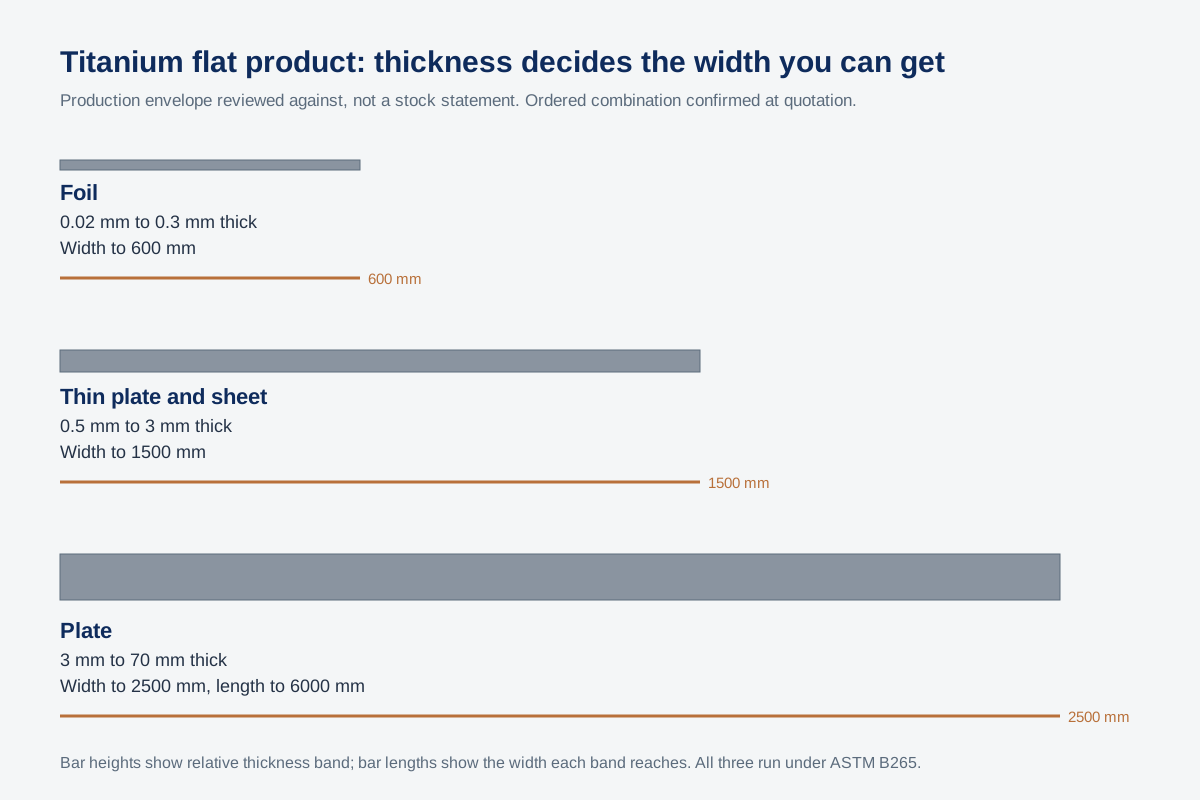
Beiyu supplies sheet and thin plate 0.5 to 3 mm thick in widths to 1500 mm, and heavy plate 3 to 70 mm thick in widths to 2500 mm, both in lengths to 6000 mm, with surface condition stated on the order.
These are Beiyu published supply figures and inspection parameters, not limits taken from the standard; limit values belong to ASTM B265 and are confirmed against the exact edition named on the purchase order. Certification is stated as a production capability, and no stock position, delivery time or price is implied by any figure on this page.