
Grade 12 titanium plate uses molybdenum and nickel to improve strength and corrosion behavior over commercially pure Grade 2 in selected conditions. The alloy designation does not answer whether the buyer receives ASTM B265 plate, thin sheet, cut blanks, a fabricated lining or a tubesheet. Five company-owned sources met the rule, and they show why service chemistry, plate geometry, heat identity, rolling/anneal route, fabrication and inspection must be compared together.
How the five company sources were selected
We froze the query Grade 12 titanium plate supplier ASTM B265 UNS R53400 on 1 September 2026. Eligible sources were owned by the supplying company and had to identify Grade 12 plate or sheet/plate plus at least one standard, size, production, surface, testing or certificate field. Beiyu, excluded-geography companies, marketplaces, directories, third-party lists and pages limited to Grade 12 tube were excluded. The resulting sequence is a dated source set, not a ranking of corrosion performance or manufacturing quality.
A public page can identify a likely supply route. It cannot prove allocated stock, current program approval, final schedule, lot compliance or suitability of material not yet produced or assigned. Those points remain dated quotation fields.
Company pages that met the rule
| Company source | Page role | Visible fields | RFQ check |
|---|---|---|---|
| ATI | Producer Grade 12 page | UNS R53400, Mo/Ni/interstitial chemistry, plate form and mechanical fields | Confirm orderable plate size, condition, specification, source and actual heat release |
| Chalco Titanium | Grade 12 sheet/plate page | B265/SB-265 range, dimensions, condition, surface and traceability fields | Separate sheet from plate and return the exact heat, size, condition and inspection package |
| TSM Technology | Titanium plate range page | Grade 12 in a B265 plate range with rolling, dimensions, surface and inspection | Verify the Grade 12-specific combination rather than relying on the overall catalogue envelope |
| Milling Metal | Grade 12 plate page | Chemistry/mechanical tables, rolling route, dimensions, annealed condition and MTR/TPI fields | Bind values and tests to the offered heat, thickness, plate and production lot |
| YUNCH Titanium | Grade 12 plate/sheet page | B265/SB-265, hot/cold rolling, dimensions, surface and certificate route | Resolve plate versus sheet, current production capability, tolerances and document scope |
Some pages advertise broad thickness envelopes. Those figures should be treated as discovery information, not proof that one mill route covers every width, length, condition and inspection combination. Heavy plate can involve different starting stock, rolling reduction, heat treatment, flattening and ultrasonic feasibility from thin sheet. Ask which plant and process route produce the exact offered thickness and which party retains the original heat and parent-plate genealogy after cutting.
Make service, plate geometry and fabrication one controlled line
| Decision | Choices visible in the source set | Required written return |
|---|---|---|
| Service basis | Fluid composition/range, temperature, pressure, aeration, velocity, deposits, crevices and upset | Supplier exceptions plus buyer/corrosion-authority disposition |
| Material identity | Grade 12 / UNS R53400 with actual molybdenum, nickel and interstitial results | Original heat/product analysis and no Grade 2/7 substitution |
| Plate definition | B265/SB-265 revision, thickness boundary, width, length, flatness, edge and allowance | Finished dimensions, tolerance source, cut plan and usable envelope |
| Production/fabrication | Melt source, rolling, anneal, surface, forming, welding or lining route | Process map, thermal history, qualification and contamination controls |
| Inspection | Chemistry, tensile orientation, dimensions, surface, UT or project-specific examination | Methods, coverage, reference, acceptance, sampling and actual reports |
Grade 12 selection should start from the process environment, but a supplier cannot replace the buyer’s corrosion design authority. Catalogue comparisons to Grade 2 or Grade 7 omit many variables that control localized attack. Record the actual stream, contaminants, cleaning chemicals, shutdown conditions, gasket/crevice geometry and temperature range, then obtain the required engineering disposition. On the material side, actual Mo and Ni heat results must remain traceable to the parent plate and all blanks. If the quotation offers sheet for a plate requirement, or a different thickness band, the standard’s dimensional and test rules may change. Make that change explicit before commercial comparison.
For a machined heat-exchanger tubesheet, start with the finished diameter, thickness, ligament map, cladding or solid-material decision, hole tolerance and machining cleanup. Specify whether UT occurs on the parent plate, after rough machining or at both stages; the scan surface, resolution and acceptance need to match section and geometry. Record rolling direction and coupon locations if mechanical orientation matters. The tube-to-tubesheet joining procedure, groove design, expansion setting, weld qualification and leak test belong to fabrication acceptance and cannot be inferred from B265 plate compliance. Packing must support the plate or rough blank without distortion and preserve heat marking after circumferential trimming.
A flue-gas-desulfurization absorber introduces slurry wear and deposit chemistry that are absent from a clean laboratory solution. Mark spray-bank shadow zones, gypsum buildup, wash-water coverage, chloride concentration under deposits, nozzle impingement and temperature excursions during outages. The lining plan should show panel seams, attachment studs, expansion joints, access-door transitions and repair patches. Establish holiday detection, vacuum-box testing and baseline thickness mapping after erection. These construction records, together with inspection access and future repair geometry, matter to lifecycle performance but are not part of the plate mill’s chemistry or tensile release.
A conflict between visible page fields is a verification prompt, not proof that a company cannot supply the item. Preserve the difference, request a clean technical return and let the purchase order control final identity, geometry, responsibility and acceptance.
Send one controlled RFQ
| RFQ line | Buyer input | Supplier return |
|---|---|---|
| Design/service | Process stream and ranges, component role, code/drawing and corrosion review | Compatibility exceptions and clear design-responsibility boundary |
| Identity | Grade 12/R53400, B265/SB-265 revision, melt/source and substitutions | Exact offered heat/source, actual chemistry, deviations and precedence |
| Plate | Thickness × width/diameter × length, flatness, edge, allowance and quantity | Finished geometry, tolerance, cut plan, weight basis and yield |
| Process/inspection | Rolling/anneal/surface, forming or machining, UT and dimensional/surface plan | Process map, ITP, methods, coverage, criteria and results |
| Documents | Original MTC, heat-treatment/UT records, parent-to-piece trace and marking | Release index and genealogy for plate, blank and remnant |
| Commercial | Raw plate or machined blank, packing, required date and destination | Current production status, MOQ, schedule, validity and exclusions |
Remove any source that cannot return the exact material, deliverable, finished geometry and acceptance evidence. Compare price, schedule and terms only after technical lines, responsibility boundary and document scope are aligned.
Where Beiyu fits
Beiyu is outside the five-company set. Its Grade 12 plate enquiry route asks for service and design basis, Grade 12/R53400 actual Mo/Ni heat results, B265/SB-265 revision, plate dimensions and tolerance, melt/rolling/anneal/surface route, forming or machining allowance, ordered UT and other inspection, original traceability, quantity, processing boundary, packing and destination. A broad manufacturing envelope is not presented as live stock or every possible combination.
The fields in this section describe only Beiyu’s published enquiry route. They do not score the companies above and do not transfer to another company’s catalogue.
Related Beiyu pages
- Grade 12 titanium plate
- Titanium plate supplier pages compared
- Titanium plate grade selection guide
- How to compare titanium quotations
Published by Beiyu Titanium. Beiyu is outside the five-company set. The sequence is a dated discovery snapshot after the stated exclusions, not a rating or endorsement.
Related supplier lists and supply ranges
- titanium sheet and plate supply range
- Alloy 625 Plate Suppliers
- Grade 23 Titanium Plate Suppliers
- Grade 5 Titanium Plate Suppliers
- Inconel 600 Plate Suppliers
- Nickel 201 Plate Suppliers
- Sintered Porous Titanium Plate Suppliers
- all supplier lists by product family
Specification detail with sources
Beiyu Titanium publishes this list and is not part of the comparison above. For readers who want the publisher’s own figures on the same basis they would ask of any supplier on this page, the material is specified to ASTM B265, and each order carries an EN 10204 type 3.1 certificate with heat and pour numbers by order scope.
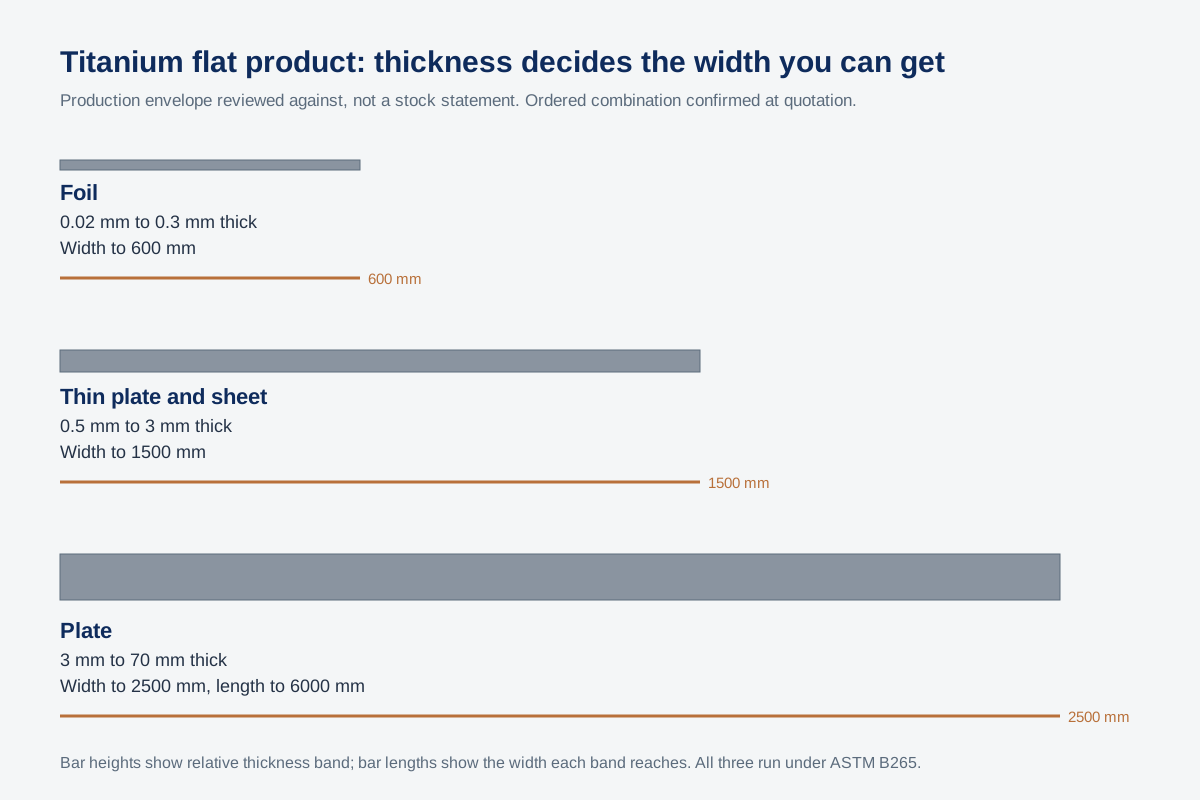
Beiyu supplies thin plate and sheet 0.5 to 3 mm thick in widths to 1500 mm, and heavy plate 3 to 70 mm thick in widths to 2500 mm, both in lengths to 6000 mm, with surface condition stated on the order.
These are Beiyu published supply figures and inspection parameters, not limits taken from the standard; limit values belong to ASTM B265 and are confirmed against the exact edition named on the purchase order. Certification is stated as a production capability, and no stock position, delivery time or price is implied by any figure on this page.