
Grades 1 to 4 are unalloyed titanium separated by oxygen and iron content. Strength rises with oxygen, from about 240 MPa minimum tensile in Grade 1 to about 550 MPa in Grade 4, while formability falls. Grade 2 is the industrial default and covers most chemical and marine service.
The four commercially pure (CP) titanium grades share similar corrosion behavior but differ in strength and formability. Picking the wrong one means either paying for strength a part does not need or specifying a grade that cannot form or machine the way the job requires. This guide covers what separates Grades 1 to 4, which grade fits which service, and the standard and form to state on the order.
Beiyu Titanium supplies CP titanium in all four grades, Grade 1 through Grade 4, as bar, sheet and plate, tube, and wire. The Grade 1 titanium data sheet carries the UNS R50250 identity for the softest of the four. EN 10204 3.1 documentation and heat or lot traceability are available by order scope; list the required results and identifiers with the CP-grade enquiry.
When the selection is for implant manufacture, Beiyu’s titanium for medical implants hub separates the ASTM F67 CP grades from Ti-6Al-4V implant specifications and the ISO 5832 system.
What actually separates CP Grades 1 to 4?
All four are unalloyed titanium. The main compositional difference is the controlled level of oxygen and iron, which climbs from Grade 1 to Grade 4 and pulls strength up while pulling ductility down. Corrosion resistance is broadly similar across all four, so the grade choice is usually a strength-versus-formability decision, not a corrosion one.
| Grade | UNS | Oxygen, max | Tensile min | Yield min | Character |
|---|---|---|---|---|---|
| Grade 1 | R50250 | 0.18% | 240 MPa (35 ksi) | 138 MPa (20 ksi) | Softest, most formable |
| Grade 2 | R50400 | 0.25% | 345 MPa (50 ksi) | 275 MPa (40 ksi) | Balanced workhorse |
| Grade 3 | R50550 | 0.35% | 450 MPa (65 ksi) | 380 MPa (55 ksi) | Higher strength |
| Grade 4 | R50700 | 0.40% | 550 MPa (80 ksi) | 483 MPa (70 ksi) | Strongest CP grade |
Values shown are ASTM B348 bar and billet minimums; confirm against the current revision and the applicable product standard, since medical work under ASTM F67 can differ from ASTM B348 on a few figures.
Which grade for corrosion service, and why is Grade 2 the default?
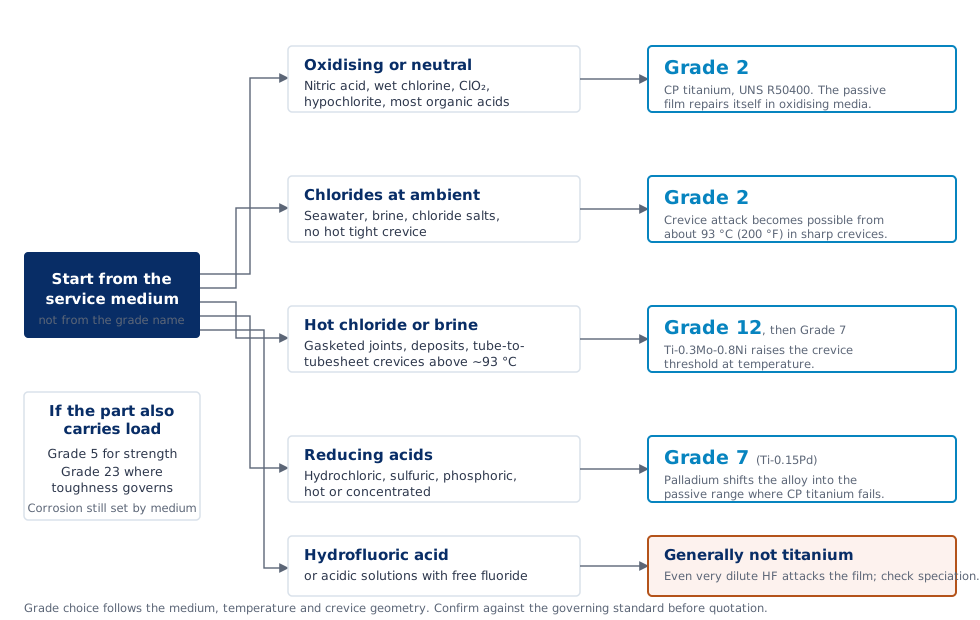
For chemical processing, marine and desalination, oil and gas, and most industrial corrosion service, Grade 2 is the default and the most-ordered CP grade. Beiyu supplies Grade 2 into chemical equipment and heat exchangers, marine and desalination hardware, and oil and gas corrosion service. It carries the full CP corrosion behavior with enough strength for piping, vessels, heat-exchanger components and structural parts, and it welds and forms well. Because corrosion behavior is common to the CP family, moving away from Grade 2 is usually driven by a strength or forming need, not a corrosion one. See our chemical industry and marine engineering applications.
For bar-focused RFQs, see Beiyu’s Grade 2 titanium bar page and the ASTM B348 titanium bar and billet guide.
When do you drop to Grade 1, or step up to Grade 3 and 4?
| Grade |
|---|
| Grade 1 when forming governs. Its higher ductility and lower strength make it the choice for deep drawing, explosive cladding, and parts shaped cold. Beiyu supplies Grade 1 for anode substrates used in electrolysis and cathodic protection, and for clad plate. |
| Grade 3 when a part needs more strength than Grade 2 but must stay commercially pure, common in pressure-containing and higher-load industrial components. |
| Grade 4 when strength is the priority among CP grades. It is used where CP corrosion behavior must combine with the highest unalloyed strength, including dental and orthopedic parts and demanding industrial fittings. |
For form-level examples around Grade 1 and porous applications, review thin titanium wire and sintered porous titanium plate; confirm the required CP grade separately from the product form on the RFQ.
If a part needs more strength than any CP grade delivers, the specification moves off CP titanium entirely to an alloy such as Ti-6Al-4V; for implant work that means ASTM F136 ELI rather than a CP grade.
Grade selection by service, at a glance
| Service / need | Typical CP grade | Why |
|---|---|---|
| Chemical, marine, desalination | Grade 2 | Full CP corrosion behavior, balanced strength, weldable |
| Deep forming, cladding, anodes | Grade 1 | Maximum ductility and formability |
| Higher-load industrial, pressure parts | Grade 3 | More strength, still fully CP |
| Highest-strength CP, dental/ortho | Grade 4 | Top unalloyed strength with CP corrosion behavior |
| Medical implant, CP | Grades 1-4 to ASTM F67 | Surgical-implant control layer, see the F67 guide |
What standard and form do you order against?
The grade is only half the order. State the product standard and form as well:
| Selection point | What the guide states |
|---|---|
| Bar and billet | ASTM B348. |
| Sheet, strip and plate | ASTM B265. |
| Seamless and welded tube | ASTM B338. |
| Wire | ASTM B863. |
| Medical CP bar | add ASTM F67 to the bar standard for surgical-implant control, covered in our guide to specifying ASTM F67 medical CP bar. |
Beiyu supplies CP titanium across all of these forms, so a project can source bar, sheet, plate, tube and wire in one grade against one documentation chain.
For medical or precision work, grain size and hydrogen limits also belong on the order; those acceptance criteria are covered in our guide to grain size and hydrogen on medical bar.
How does the grade show up on the certificate?
The grade sets the chemistry and mechanical minimums the mill certifies. If the order requires EN 10204 3.1, state the chemistry, mechanical results and heat or lot traceability fields in the RFQ. Stating grade, standard, form, dimensions and any medical or metallurgical requirement together lets the mill quote against the intended acceptance scope.
Frequently asked questions
Is Grade 2 titanium the same as commercially pure titanium?
Grade 2 is one of four commercially pure titanium grades, Grades 1 to 4. It is the most widely ordered because it balances strength, ductility and corrosion behavior, but Grades 1, 3 and 4 are equally commercially pure.
Do the CP grades differ in corrosion resistance?
For many industrial environments, the CP grades behave similarly in corrosion service; they mainly differ in strength and ductility, set by oxygen and iron content. Grade choice should still be checked against the exact medium, temperature and design stress.
Which CP grade is strongest?
Grade 4, with a minimum tensile strength around 550 MPa (80 ksi), is the strongest commercially pure grade, at the cost of lower ductility than Grades 1 and 2.
Which grade should I use for a medical implant?
Commercially pure implant parts are specified to ASTM F67 across Grades 1 to 4; higher-load implants move to Ti-6Al-4V ELI under ASTM F136. See Beiyu’s F67 and F136 guides.
How the interstitial figures that separate these grades are measured
Grades 1 to 4 are separated almost entirely by oxygen, nitrogen, carbon and iron. Since the grade boundary is a number, the method that produced the number is part of the acceptance basis rather than a laboratory detail.
| Element | Method ASTM B348 references | Why it matters between CP grades |
|---|---|---|
| Oxygen and nitrogen | ASTM E1409 | Oxygen is the main lever between Grade 1 and Grade 4, so its basis has to be stated |
| Hydrogen | ASTM E1447 | The tightest limit in the group, and the one least visible on a shop floor |
| Carbon | ASTM E1941 | Reported by combustion rather than an unstated technique |
| Rounding of reported values | ASTM E29 | Decides whether a borderline interstitial figure passes at all |
Naming a method settles how a value was produced. It does not add an examination the order did not ask for, and it does not make a heat analysis and a later product analysis interchangeable.
Heat analysis and product analysis on a CP grade order
| Analysis | What it is | What it does not do |
|---|---|---|
| Heat analysis | The acceptance basis for the grade limits | Nothing further; the limits are the limits |
| Product analysis | A later check on the finished item, with its own tolerance under ASTM B348 | It does not loosen the grade limits, and material outside them is not made acceptable by it |
Where a receiving laboratory reports an interstitial figure marginally over a CP grade limit, the first question is which analysis is being quoted and whether the rounding practice the standard names was applied before the comparison.
Specification detail with sources
The four CP grades are separated mainly by oxygen: ASTM B265 limits oxygen to 0.18 wt% (Grade 1), 0.25 wt% (Grade 2), 0.35 wt% (Grade 3) and 0.40 wt% (Grade 4). Iron limits move with them, 0.20 wt% for Grade 1 against 0.50 wt% for Grade 4.
| Grade | Oxygen limit per ASTM B265 |
|---|---|
| Grade 1 | 0.18 wt% |
| Grade 2 | 0.25 wt% |
| Grade 3 | 0.35 wt% |
| Grade 4 | 0.40 wt% |
Selection is a strength against formability trade at constant weight: minimum ultimate tensile strength rises from 240 MPa (Grade 1) to 550 MPa (Grade 4) while minimum elongation falls from 24 to 15 percent (ASTM B265, mechanical requirements), and density stays near 4.51 g/cm³ across all four grades (ASM Handbook, Volume 2).
Request a quote for CP titanium bar, sheet, tube or wire
Use the titanium RFQ checklist to make sure grade, standard, form, dimensions, tolerance, quantity and certificate scope are stated together.
To quote commercially pure titanium, Beiyu needs: grade (CP 1/2/3/4), product standard (B348 bar, B265 sheet, B338 tube, plus F67 for medical), form, dimensions and tolerance, condition, and any grain-size or hydrogen requirement. Send the drawing or spec and we review each line against mill capability before quoting, with EN 10204 3.1 MTC and heat-number traceability by order scope. Contact Beiyu Titanium for an RFQ.
Related Beiyu resources
- Grade 2 Titanium Bar | ASTM B348 Commercially Pure Titanium
- ASTM F67 Titanium Bar: Medical-Grade CP Bar for Machining
- Grain Size and Hydrogen on Medical Titanium Bar
- Titanium Materials for Chemical Industry
- Titanium Materials for Marine Engineering
Reference sources
- ASTM B265, Standard Specification for Titanium and Titanium Alloy Strip, Sheet, and Plate
- ASTM B348, Standard Specification for Titanium and Titanium Alloy Bars and Billets
- ASTM F67, Standard Specification for Unalloyed Titanium, for Surgical Implant Applications
- ASM Handbook, Volume 2, Properties and Selection: Nonferrous Alloys and Special-Purpose Materials
- TIMET, Corrosion Resistance of Titanium (technical manual)