
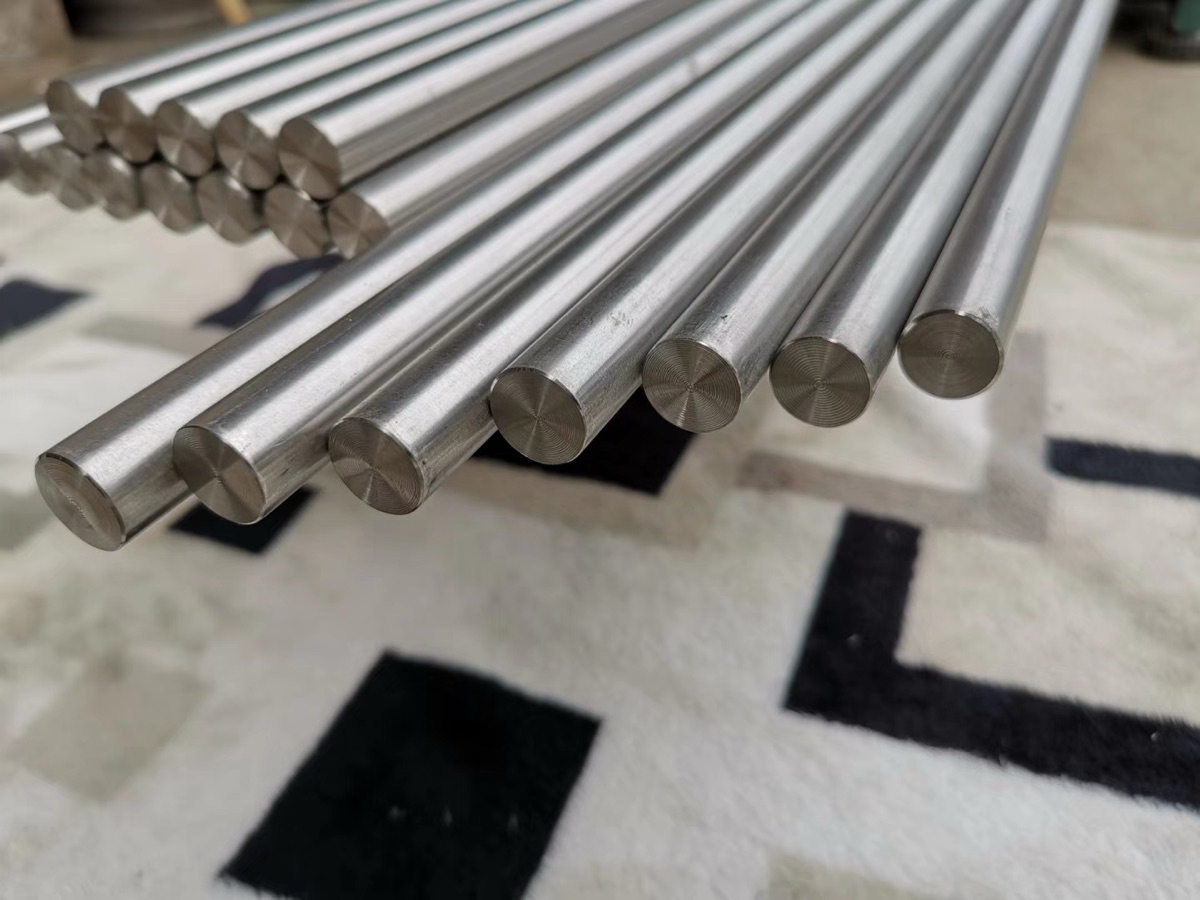
Titanium bar machines predictably when you start from annealed stock in the right grade, run sharp carbide at a controlled speed, and never let the tool rub. Titanium conducts heat at roughly one sixth the rate of steel, so heat piles up at the cutting edge, and a feed rate that is too low work-hardens the surface and wrecks the next pass. Pick the grade and condition first, then set speeds and feeds, then flood the cut.
Why titanium fights the tool
Two properties drive almost every titanium machining problem:
- Low thermal conductivity. Ti-6Al-4V conducts heat at about one sixth the rate of steel. The heat that would normally leave in the chip stays in the cutting zone and concentrates on the edge, so tools fail from heat, not abrasion.
- Work hardening. If the edge rubs instead of cutting, the surface skin hardens immediately. The next revolution then cuts a harder layer, which accelerates wear. Machinists call the fix “feed or flee”: keep cutting or get out, but never dwell.
Titanium also has a low elastic modulus, so thin parts deflect and spring back, and it is chemically reactive at temperature, which is why a dull edge and a galled chip ruin a finish fast.
Start with the right grade and condition
Machinability is decided before the bar reaches the lathe:
| Machining point |
|---|
| Grade 2 (commercially pure) is the most forgiving to machine and weld, used for corrosion hardware. |
| Grade 5 / Ti-6Al-4V is stronger and harder on tools, but the workhorse for machined structural parts. For aerospace specification stock see Ti-6Al-4V to AMS 4928. |
| Grade 23 (Ti-6Al-4V ELI) behaves like Grade 5 with tighter cleanliness for toughness-critical parts. |
Condition matters as much as grade. Annealed bar machines more predictably than solution-treated-and-aged (STA) bar, which is harder and more abrasive. If the part allows it, machine in the annealed condition. See annealed vs STA titanium bar for what to put on the order. If the alloy is not fixed yet, choose it in the titanium bar grade selection guide before setting condition and cutting allowance.
Speeds and feeds that hold up
Use sharp coated carbide built for titanium. These are starting points, not limits; tune by tool, rigidity and coolant.
| Operation | Ti-6Al-4V starting speed | Feed |
|---|---|---|
| Turning (coated carbide) | 30 to 60 m/min (about 100 to 200 SFM) | moderate; keep a real chip load |
| Milling (coated carbide) | 25 to 50 m/min | at or above 0.05 to 0.12 mm/tooth |
| Feed floor | keep above ~0.002 in (0.05 mm) per tooth | below this the edge rubs and work-hardens |
Speed is the sensitive variable. Because of the Taylor tool-life relationship, raising cutting speed by 10 percent can cut tool life by 30 to 50 percent. When in doubt, drop speed and hold the feed.
Beating work hardening and tool wear
| Condition and finish |
|---|
| Run sharp tools and replace them before they go dull; a dull edge rubs, hardens the surface and ruins the finish. |
| Never let the tool dwell or rub. Maintain a constant chip load and feed into the cut. |
| Prefer climb milling and avoid re-cutting the work-hardened skin from a previous pass. |
| Use high-pressure flood coolant aimed at the edge to pull heat out of the cutting zone. Heat control is the main lever on tool life. |
| Keep the setup rigid. Deflection on slender bar causes chatter and re-cutting. |
Buying bar stock that machines predictably
Half of a clean titanium job is the incoming bar. When ordering bar stock to machine:
| Field to state |
|---|
| Specify the annealed condition unless the part needs STA strength. |
| Ask for the mill test certificate with chemistry and mechanical results by heat, so hardness and strength are known before you cut. |
| Give the diameter tolerance and straightness you need for fixturing; cold-finished bar holds tighter than hot-rolled. See titanium bar forms and tolerances. |
| Add stock removal allowance over the finished size, especially on hot-rolled bar with a heavier surface. |
Frequently asked questions
Why does my titanium tool wear out so fast?
Heat. Titanium conducts heat at about one sixth the rate of steel, so it concentrates on the cutting edge. Lower the speed, hold the feed, run sharp carbide and flood the cut.
What causes work hardening when machining titanium?
The edge rubbing instead of cutting. A feed rate that is too low, or a dull tool, hardens the surface skin so the next pass cuts a harder layer. Keep the feed above roughly 0.002 in per tooth and never dwell.
Is Grade 2 easier to machine than Grade 5?
Yes. Commercially pure Grade 2 is softer and more forgiving; Grade 5 (Ti-6Al-4V) is stronger and harder on tools. Annealed stock of either grade machines more predictably than STA.
Should I machine titanium annealed or in the STA condition?
Machine annealed where the part allows; STA bar is harder and more abrasive. Confirm the condition on the bar order.
How these figures are derived
The speed and feed ranges above are typical starting points for coated carbide on Ti-6Al-4V, drawn from carbide tooling machining data for titanium alloys. Treat them as a baseline and tune to your tool, rigidity and coolant. The heat behaviour reflects published titanium materials data: Ti-6Al-4V conducts heat at roughly one sixth the rate of carbon steel, which is why heat concentrates at the cutting edge. The grade, condition and bar tolerances referenced here follow ASTM B348 (titanium bar and billet), AMS 4928 (aerospace Ti-6Al-4V bar) and AMS 2241 (titanium bar and wire tolerances). Confirm final cutting parameters against your tooling supplier’s data, and confirm grade and condition against the mill test certificate for the specific heat.
The stock fields that decide cycle time before the first cut
Machining outcomes are usually discussed as tooling and parameters. The input material decides a large part of it, and those fields are set on the purchase order rather than at the machine.
| Field | What it changes on the machine |
|---|---|
| Diameter tolerance | Whether the bar runs in a collet without re-truing |
| Straightness | Feeding, chatter and bar loader behaviour |
| Surface condition | Machining allowance and whether a contaminated layer must be removed |
| Delivery condition | The metallurgical state, which the finish does not imply |
What Beiyu publishes on the precision ground bar route
These apply to the documented centerless ground route from 3.175 mm to 25.4 mm diameter, as a production capability reviewed against rather than a stock statement.
| Field | Published value |
|---|---|
| Diameter tolerance | ±0.0127 mm (±0.0005 in), tightened to ±0.0076 mm on request |
| Straightness | 0.5 mm per metre, and 0.3 mm per metre on diameters up to 25 mm |
| Examination | Ultrasonic, eddy current, optical surface, laser diameter and straightness, each at 100 percent of the lot |
| Certificate | EN 10204 3.1 mill test certificate with heat number traceability |
These controls belong to the quoted precision program and are not carried across to the full 1 mm to 500 mm round bar envelope.
Specification detail with sources
Machining behaviour of titanium bar traces to published property data before it traces to tooling choices. ASM Handbook data put the room-temperature thermal conductivity of Ti-6Al-4V near 6.7 W/m·K and its elastic modulus near 114 GPa, the two constants behind the heat concentration and workpiece deflection described above. On the load side, ASTM B348 sets minimum tensile strength at 345 MPa for Grade 2 against 895 MPa for Grade 5, which is most of the machinability gap between the two grades in one pair of numbers.
Beiyu Titanium supplies machining bar in the section shapes shops fixture directly: square bar from 3 x 3 mm to 500 x 500 mm, flat bar from 3 x 12.7 mm to 30 x 500 mm and hexagonal bar up to 17 mm across flats, alongside rounds, each released in one of the three delivered conditions coded R, M and Y on the mill sheet, which is a separate order field from the surface. For tolerance-critical stock, Beiyu quotes bar to ISO tolerance classes h6 through h9 with polished or sandblasted surfaces, so the diameter allowance a programmer plans around is set at the mill rather than recovered on the first cut.
Request titanium bar stock
Send the grade, condition, size, tolerance and documents you need and Beiyu will confirm the stock against your machining plan before quotation. Contact [email protected].