
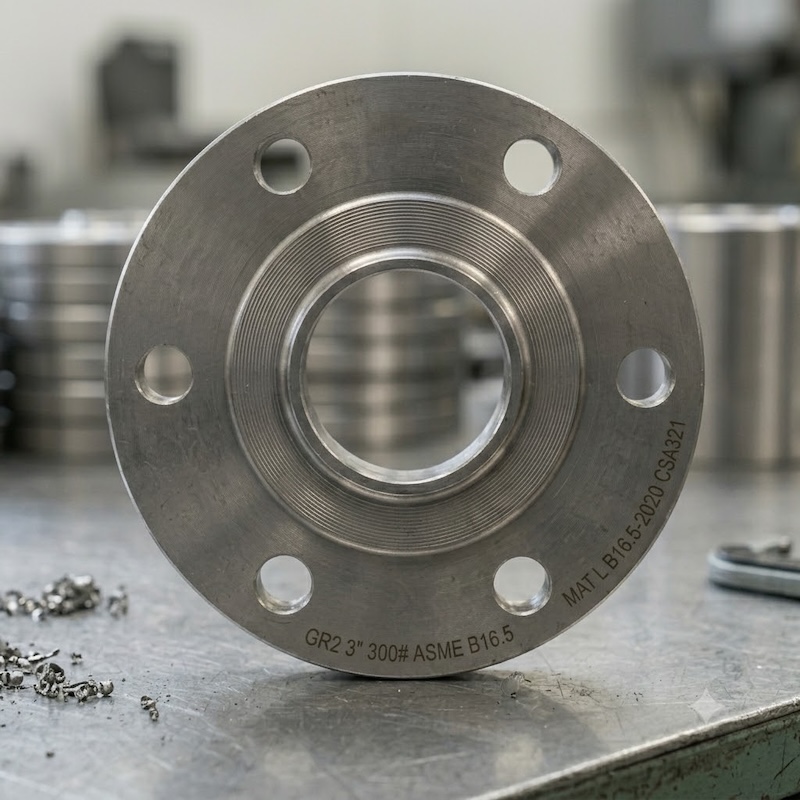
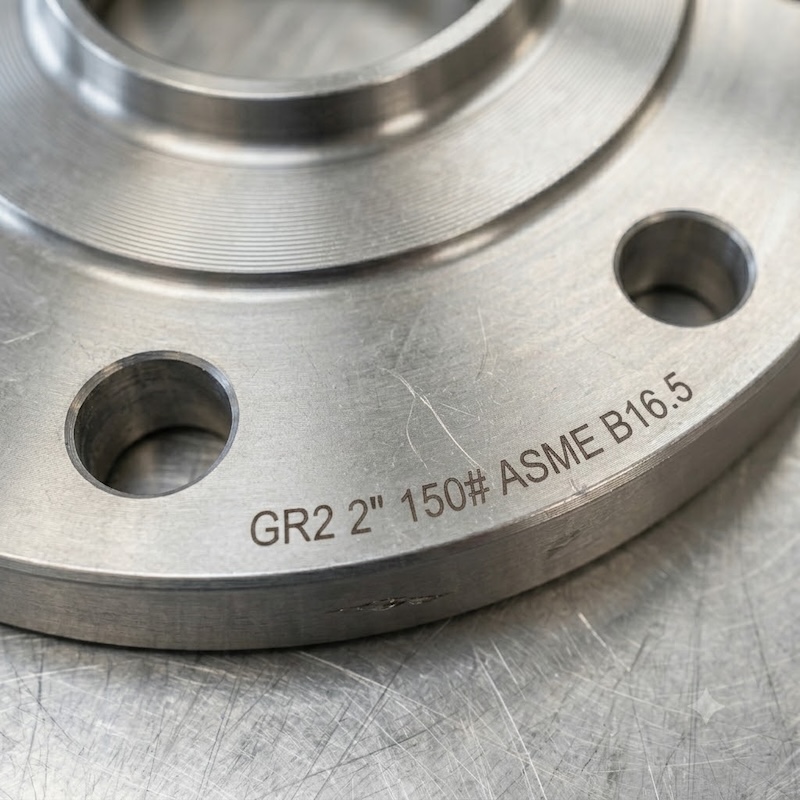
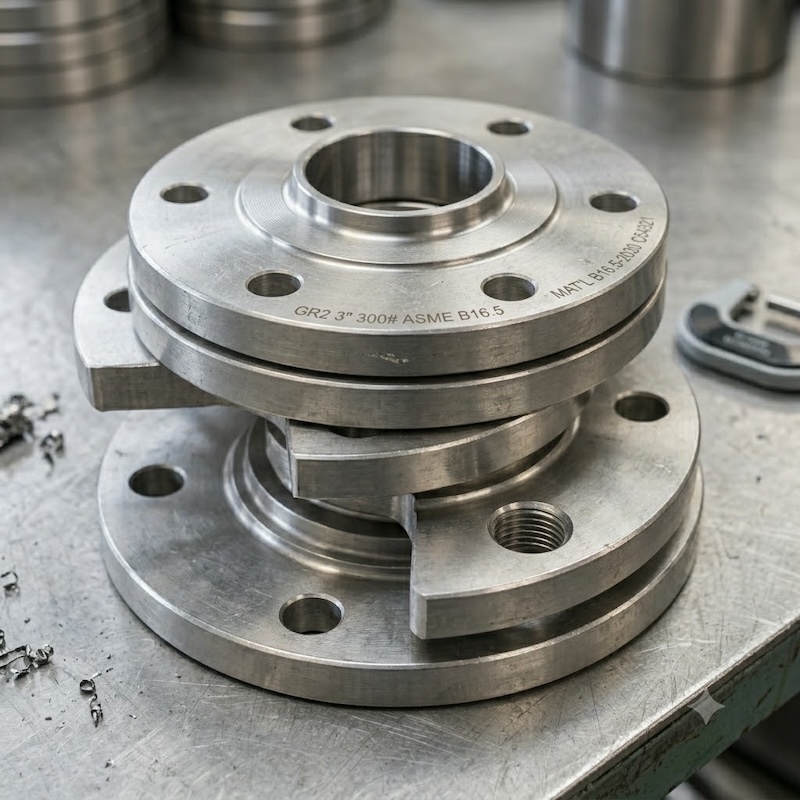
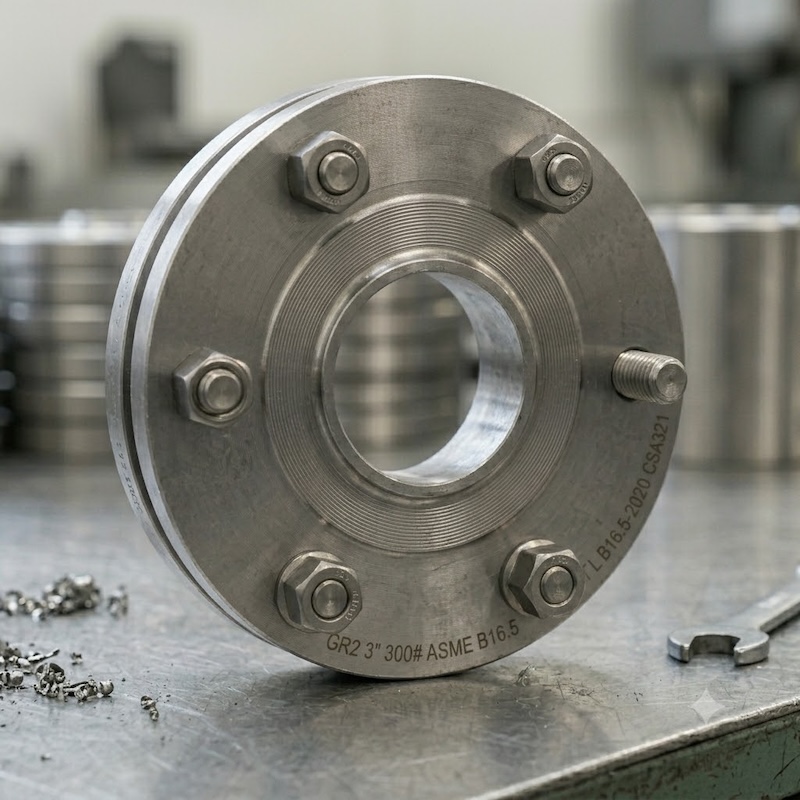
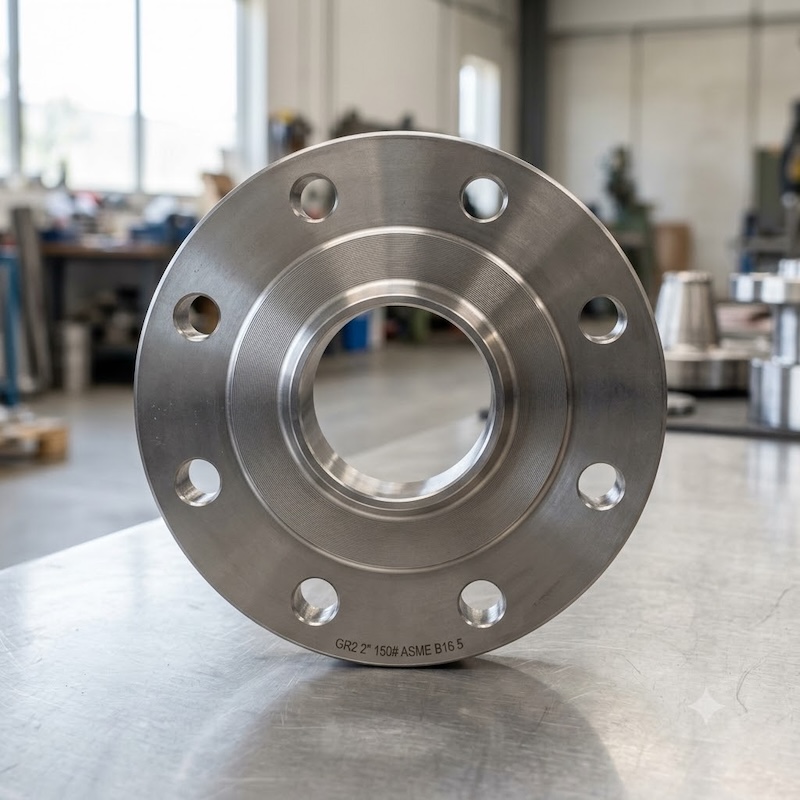


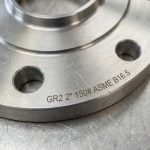




ASTM B381Forged titanium flange reference
Grade 2Commercially pure titanium
NPS / classDimensions by drawing or standard
MTC / 3.1Heat traceability on request
Acceptance is by the ordered specification. Final dimensions, tolerances, grade, inspection and documentation are confirmed by the drawing, purchase order and mill test certificate.
Grade 2 Titanium Flange for Corrosion-Resistant Piping Systems
Grade 2 titanium flange is used to connect titanium pipe, valves, pumps, heat exchangers and process equipment in corrosive service. It is often specified for chemical processing, seawater systems, desalination, chlorination equipment and other applications where stainless steel may suffer from chloride corrosion.
Flange purchasing should be based on drawing, standard, pressure class, sealing face, bolt pattern and material grade. A flange description without these details is not enough for production or inspection. Buyers should also confirm whether forged, machined or plate-cut flanges are acceptable under the project specification.
Grade and Standards
| Grade | UNS | Common Standard | Typical Use |
|---|---|---|---|
| Grade 2 titanium | UNS R50400 | ASTM B381, drawing requirement | General corrosion-resistant titanium flanges |
| Grade 7 titanium | UNS R52400 | ASTM B381 where specified | More severe chemical service |
| Grade 12 titanium | UNS R53400 | ASTM B381 where specified | Chemical and heat-exchanger service requiring Ti-0.3Mo-0.8Ni |
Flange Types and Machining Details
Common titanium flange enquiries include weld neck, slip-on, blind, socket weld, threaded, lap joint and custom machined flanges. RFQs should define nominal size, pressure class, standard, bore, bolt circle, bolt hole quantity, thickness, sealing face and whether raised face, flat face or special serration is required.
Applications
- Chemical process piping and corrosion-resistant transfer lines
- Seawater, desalination and marine piping systems
- Heat exchanger nozzles and titanium tube-side connections
- Chlorination, sodium hypochlorite and electrochemical equipment
- Pump, valve and vessel connections requiring titanium wetted parts
Inspection and Documentation
Inspection may include dimensional checks, sealing face inspection, bolt-hole verification, visual inspection, PMI testing and review of chemical composition and mechanical properties. For project orders, buyers should state whether EN10204 3.1 mill test certificates, heat number marking, pressure rating documents or third-party inspection are required.
Packaging and Export Information
Titanium flange sealing faces and machined surfaces should be protected from scratches during packing. Flanges may be wrapped individually, separated with protective material and packed in wooden cases or pallets. Each package should identify grade, standard, size, pressure class, heat number and PO line item.
RFQ Information Needed
- Grade, ASTM B381 or drawing standard
- Flange type, nominal size, pressure class and sealing face
- Bore, bolt pattern, thickness and drawing if custom
- Quantity, marking, certificate and inspection requirement
- Connected pipe grade and service medium if available
FAQ
Is Grade 2 titanium common for flanges?
Yes, Grade 2 is widely used for titanium flanges in corrosion-resistant piping when the service condition is suitable.
What standard should be used for titanium flanges?
ASTM B381 is commonly used for titanium forgings, but flange dimensions and pressure class should also follow the project drawing or piping standard.
What information is needed for a custom titanium flange?
Provide drawing, grade, pressure class, sealing face, bolt pattern, quantity, tolerance and certificate requirement.
Quotation Checklist for Grade 2 Titanium Flange
For Grade 2 titanium flange quotations, include the dimensional standard or drawing, pressure class, flange facing, gasket contact surface, bolt-hole details, bore, required marking and whether mating titanium pipe dimensions are already fixed. For custom flanges, send a drawing in PDF or DWG format and note any inspection hold points or third-party witness requirements.
Include gasket standard, mating pipe schedule and required spare quantity when requesting final pricing.
Flange RFQ and Inspection Notes
Grade 2 titanium flanges should be quoted by flange type, nominal size, pressure class, facing, bolt hole pattern, thickness, standard and sealing-surface requirement. If the flange is used in chemical or seawater service, include the mating pipe standard and gasket requirement so the dimensions can be checked.
Inspection may include dimensional checks, surface inspection, PMI, material certificate and heat-number traceability. Flange faces and sealing surfaces should be protected during export packing to avoid scratches before installation.
Common applications
Review fabrication and machining support22
Ti
Titanium
Chemical process pipe connectionsConfirm medium, temperature, drawing tolerance, inspection and documentation scope before quotation.Seawater and chloride-service linesConfirm medium, temperature, drawing tolerance, inspection and documentation scope before quotation.Heat exchanger and vessel nozzlesConfirm medium, temperature, drawing tolerance, inspection and documentation scope before quotation.Drawing-based titanium piping assembliesConfirm medium, temperature, drawing tolerance, inspection and documentation scope before quotation.
What a flange order carries beyond the grade and the size
A flange is bought to a dimensional standard and accepted to a material standard, and the two are separate documents. An order that names only one leaves the other to a default.
| Field | What it controls | Where it belongs |
|---|---|---|
| Dimensional standard and rating | Bolt circle, face and thickness | Named alongside the size |
| Material standard with the grade | The acceptance basis for the metal | Its own line |
| Facing and surface finish | Sealing behaviour against the mating face | Stated apart from the delivery condition |
| Examination scope | What is inspected and to which acceptance class | The purchase order text |
What the material certificate should carry
| Field | Beiyu position |
|---|---|
| Certificate type | EN 10204 3.1 mill test certificate |
| Traceability | Heat number, carried through to the delivered pieces |
| Grade with its UNS number | Given together and consistent with the standard the order names |
| Reporting scope | Set by the order, which is why the order should state it |
Two standards named and a reporting scope stated turn a flange enquiry into something that can be priced on the first pass.
Compare titanium flange and connection products
Titanium tube and pipe category| Product | Material | Reference | Best for | Link |
|---|---|---|---|---|
| Titanium Flanges | Gr2 / Gr5 / Gr7 / Gr12 | ASTM B381 | Pipe connection RFQs | View |
| Titanium Pipe Fittings | Gr2 / Gr7 / Gr12 | ASTM B363 | Elbows, tees and reducers | View |
| Titanium Fasteners | Gr2 / Gr5 | DIN / ISO / ASTM | Bolts, nuts and screws | View |
| Grade 2 Titanium Flange | Grade 2 | ASTM B381 | Commercially pure titanium flange | Current page |
Related RFQ pages
Titanium accessories category
For a view of who else publishes this material and what each one states, see Grade 2 Titanium Flange Suppliers: Five Company Pages Compared.
Request a quote for Grade 2 Titanium Flange | ASTM B381 Titanium Pipe Flange
Send grade, drawing or standard, dimensions, quantity, inspection scope and delivery destination. Beiyu replies with quotation, lead time and documentation scope.
Specification detail with sources
ASTM B381 is the material route for annealed titanium and titanium-alloy forgings; its scope identifies Grade F-2 as unalloyed titanium, UNS R50400, and says purchaser-specified nondestructive tests apply when required. Use the forging material and order fields to check the grade and acceptance basis, but do not treat them as the flange dimensional standard.
ASME B16.5 covers pressure-temperature ratings, materials, dimensions, tolerances, marking, testing and opening designations for pipe flanges and flanged fittings within its stated size and class scope. That route does not by itself select Grade F-2 or establish stock: the RFQ still needs NPS, class, flange type and face, bore, bolt pattern or mating detail, drawing or edition, quantity and inspection hold points, with the required certificate fields named before quotation.
Specification for Grade 2 commercially pure titanium forged flanges
These are the fields an order line needs. The mechanical requirement that applies is the one in ASTM B381 for the ordered form, size range and condition, so it is confirmed against the ordered standard at quotation rather than carried across from another product standard.
| Field | Value |
|---|---|
| Grade | Grade 2 commercially pure titanium |
| UNS designation | R50400 under ASTM B381 |
| Werkstoff number | 3.7035 |
| Controlling standard | ASTM B381 |
| Selected composition limits, mass percent | Unalloyed Ti, O 0.25 max, Fe 0.30 max. Full chemistry is per the governing specification. |
| Dimensional standard | ASME B16.5, with class and facing stated on the order |
| Supply condition | R / M, stated on the order |
Dimensions
Flange dimensions come from the dimensional standard rather than from a size envelope. State the ASME B16.5 class and facing with the nominal pipe size on the order, or send the drawing where the flange is to a customer specification.
Inspection and documentation
The inspection scope is set by the order rather than assumed. State which examinations are required, to which acceptance standard and class, and at which stage they are performed, because those four fields are what make an inspection line objectively verifiable during receiving inspection.
Acceptance criteria you can paste into your purchase order
Grade and standard: Grade 2 commercially pure titanium, ASTM B381, UNS R50400
Form and dimensions: ______
Tolerance: ______
Condition: ______ (R / M, stated on the order)
Surface: ______ (state a roughness value where it is an acceptance criterion)
Form tolerance: ______
Inspection scope: ______ (examination, acceptance standard, class and stage)
Certificate: EN 10204 3.1 inspection certificate, chemistry traceable to heat number, mechanical results and inspection lot identification per the governing specification
Send the drawing or purchase specification with those fields filled in and the enquiry is reviewed against the applicable standard before pricing.