
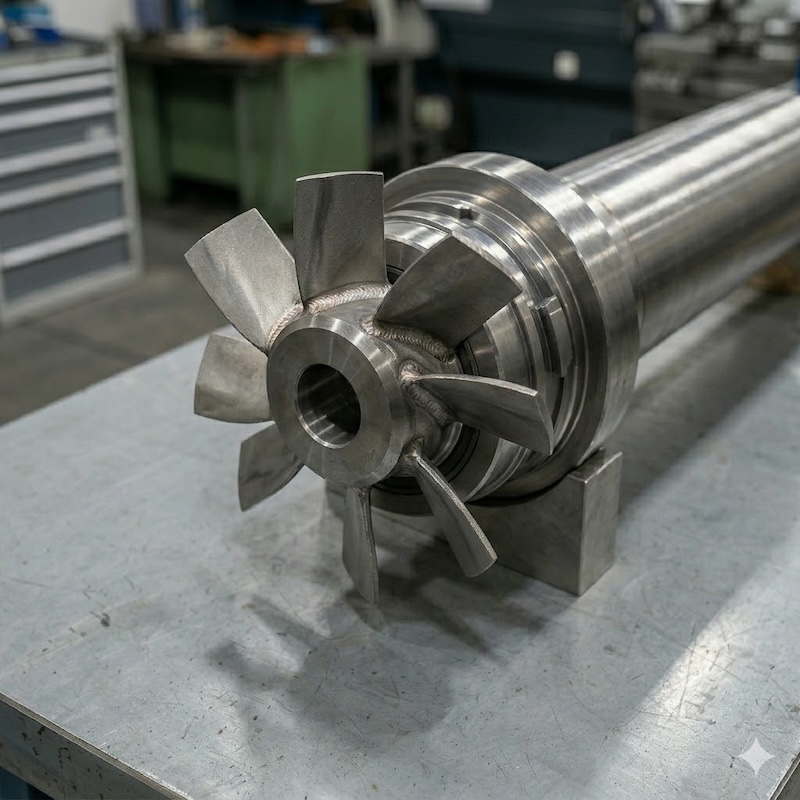
A titanium agitator shaft cannot be purchased safely as a bar with two end details. Torque, speed, unsupported length, critical-speed margin, deflection, impeller loading, coupling and process corrosion belong to one rotating-system calculation. Five company-owned sources met the rule, ranging from engineered industrial shafts to smaller stirring products and specialist repair fabrication.
How the five company sources were selected
We froze the query titanium agitator shaft supplier mixer manufacturer on 1 September 2026. Eligible sources were company-owned pages or official brochures that expressly showed or named a titanium agitator, mixer or stirring shaft and exposed construction, design, material, balance or service context. Beiyu, geographies excluded by site policy, marketplaces, directories and generic titanium-bar pages were excluded. The order is a dated discovery record, not a reliability score.
A public page can identify a likely supply route. It cannot prove the allocated lot, current schedule, final inspection result or suitability of equipment/material not yet produced or assigned. Those points remain dated quotation fields.
Company pages that met the rule
| Company source | Page role | Visible fields | RFQ check |
|---|---|---|---|
| Sulzer | Industrial agitator case study | Hollow single-piece Grade 2 titanium shaft/impeller in hot ferric-chloride service with attributed geometry and speed | A case configuration is not a catalogue limit; return calculations and the new project duty |
| ProQuip | Tank agitator shaft design page | Titanium among available alloys; solid/tubular construction and critical-speed/deflection design context | Return material, construction, critical-speed margin and maximum deflection |
| SHINTO/Heidon | Titanium stirring-shaft products | Small titanium shaft/impeller forms for laboratory mixers | Do not scale a laboratory connection or impeller into an industrial reactor duty |
| NOV/Chemineer | High-torque mixer brochure | Official brochure naming titanium among shafting materials that can be machined and straightened | Return the actual alloy, shaft design, coupling, impeller and acceptance calculations |
| Prime Machine | Mixer-shaft fabrication job | Machined, welded and dynamically balanced titanium mixer shaft | A job page proves a fabrication example, not design ownership or current capacity |
The set spans OEM agitator design, a published industrial case, small stirring tools and a repair/fabrication job. Those roles cannot be placed in one capacity ranking. First decide whether the supplier owns the mixer design, builds to a buyer drawing or only machines/repairs shaft parts; then compare the returned engineering and inspection package.
Treat the shaft as a rotating system, not round stock
| Decision | Choices visible in the source set | Required written return |
|---|---|---|
| Design ownership | OEM mixer selection, build-to-print shaft or repair scope | Named party responsible for torque, critical speed, fatigue and process suitability |
| Duty loads | Power, speed, torque, impeller thrust, bending and transient/start-up loads | Load cases, service factor and calculation summary tied to the selected geometry |
| Shaft construction | Solid, tubular, one-piece or joined; free length and diameter changes | Drawing, wall/section, straightness, runout, weld/joint and machining allowances |
| Material/corrosion | Titanium grade by wetted zone, crevices and galvanic interfaces | Material map, isolation details, surface/cleaning and lot traceability |
| Dynamic acceptance | Critical-speed margin, deflection, balance, alignment and vibration | Methods, limits, operating envelope and measured results |
A larger diameter is not automatically safer if a coupling, weld, keyway, diameter transition or long unsupported span controls fatigue or resonance. Give the supplier liquid level, density, viscosity, solids, vessel internals, impeller location and every operating speed, including variable-speed bands. For a tubular shaft, define the end closures and inspection access. For a joined shaft, identify the joint type and how alignment, weld quality and heat tint/contamination will be controlled. The runout datum must be named at the coupling and impeller locations rather than stated as one unreferenced value.
A page conflict is a verification prompt, not a finding that a company cannot supply the item. Preserve the observed conflict, request a clean technical return and make the purchase order control the final identity, geometry, responsibility and acceptance route.
Send one controlled RFQ
| RFQ line | Buyer input | Supplier return |
|---|---|---|
| Process duty | Fluid, temperature, density/viscosity, solids, liquid levels and corrosion conditions | Material assumptions and excluded duty cases |
| Drive/load | Motor power, speeds, gearbox, start/stop cases, impeller and thrust/torque data | Design loads, service factor and calculation responsibility |
| Geometry | Free length, solid/tubular route, interfaces, impeller stations and drawing datums | Signed drawing, section, straightness/runout and tolerances |
| Material/joints | Grade map, forging/tube basis, couplings, welds and surface/cleanliness | Lot traceability, WPS/PQR scope and joint inspection |
| Dynamic checks | Critical-speed margin, deflection, balance, alignment and vibration limits | Calculation and measured report with methods and criteria |
| Commercial | Quantity, spares, documents, packing, required date and destination | Current schedule, validity, exclusions and shipping protection |
Remove any source that cannot return the exact material, deliverable, finished geometry and acceptance evidence. Compare commercial terms only after the technical lines, responsibility boundary and document scope are aligned.
Where Beiyu fits
Beiyu is outside the five-company set. Its agitator-shaft route asks for process duty, motor/gearbox and speed range, torque/load cases, impeller, free length, solid or tubular construction, titanium grade, interfaces, straightness/runout, balance, weld/NDE and drawing/document scope. A material quotation is not presented as a completed mixer design.
The fields in this section describe only Beiyu’s published enquiry route. They do not score the companies above and do not transfer to another company’s catalogue.
Related Beiyu pages
- Titanium agitator shafts
- Titanium bar supplier pages compared
- Titanium chemical-equipment fabricator pages compared
- How to compare titanium quotations
Published by Beiyu Titanium. Beiyu is outside the five-company set. The sequence is a dated discovery snapshot after the stated exclusions, not a rating or endorsement.
Related supplier lists and supply ranges
- Titanium Fasteners
- Grade 2 Titanium Flange Suppliers
- Grade 5 Titanium Fastener Suppliers
- Grade 5 Titanium Forged Block Suppliers
- Grade 7 Titanium Strip Suppliers
- On-Site Sodium Hypochlorite Generator Manufacturers
- all supplier lists by product family
Specification detail with sources
Beiyu Titanium publishes this list and is not part of the comparison above. For readers who want the publisher’s own figures on the same basis they would ask of any supplier on this page, the material is specified to ASTM B348, and each order carries an EN 10204 type 3.1 certificate with heat and pour numbers by order scope.
Round bar runs 1 to 500 mm diameter in lengths to 6000 mm, and the precision ground route covers 3.175 to 25.4 mm diameter at +/-0.0127 mm. This item is quoted from the drawing rather than from a fixed size table, so the ordered dimensions, tolerances and acceptance criteria come from the drawing and the purchase order.
These are Beiyu published supply figures, not limits taken from the standard; limit values belong to the standards named above and are confirmed against the exact edition on the purchase order. Certification is stated as a production capability, and no stock position, delivery time or price is implied by any figure on this page.