
ASTM F67 covers four grades of unalloyed titanium for surgical implant applications, including bar. Specify the grade, edition, condition, finish and inspection requirements. Precision centerless grinding is available; dual certification to ASTM B348 requires separate confirmation of compliance with both ordered specifications.
Medical device machinists ordering commercially pure titanium bar to ASTM F67 need more than a grade number. The finish, diameter tolerance, grain size, and hydrogen limit decide whether the bar runs clean on a Swiss lathe and passes incoming inspection. This guide covers what ASTM F67 actually specifies, how it pairs with ASTM B348, and the parameters a buyer should state on every RFQ.
Beiyu Titanium supplies precision centerless ground CP titanium bar. State the required ASTM F67 edition and any separate ASTM B348 requirement in the RFQ. Beiyu confirms the material route, EN 10204 3.1 reporting scope and heat or lot traceability before order release.
For the wider application context, start with Beiyu’s medical titanium materials overview; for a buyer-side comparison of implant grades, see the ASTM F67 vs F136 medical titanium guide.
This F67 guide is part of Beiyu’s titanium for medical implants hub, which maps CP and Ti-6Al-4V grades to the applicable ASTM and ISO material standards.
What does ASTM F67 cover, and which CP grade do you need?
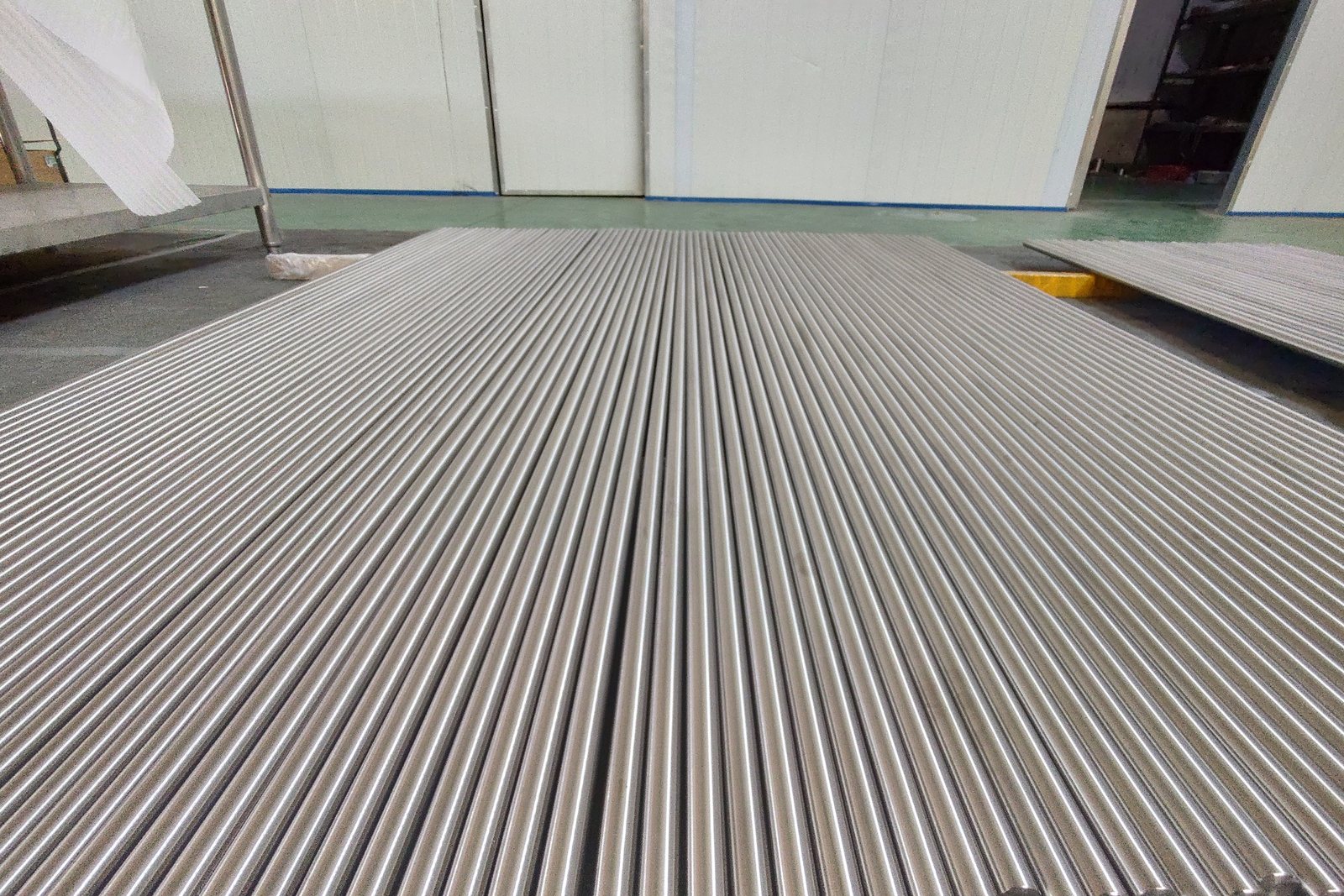
ASTM F67 is the specification for unalloyed (commercially pure) titanium for surgical implant applications, covering Grades 1 through 4 in bar, billet, wire, sheet, plate and forgings. The four CP grades differ by controlled oxygen and iron content: oxygen rises from Grade 1 to Grade 4, which raises strength and lowers ductility.
- Grade 1 (UNS R50250): lowest strength, highest ductility and formability. Chosen where cold forming or maximum corrosion resistance matters more than strength.
- Grade 2 (UNS R50400): the workhorse CP grade. Best balance of strength, ductility and weldability, and the most commonly ordered medical CP bar.
- Grade 3 (UNS R50550): higher strength than Grade 2, still fully CP and biocompatible.
- Grade 4 (UNS R50700): highest-strength CP grade, used where a device needs CP corrosion behavior with more load capacity.
| Grade | UNS | Oxygen, max | Tensile strength, min | Yield strength, min (0.2% offset) |
|---|---|---|---|---|
| Grade 1 | R50250 | 0.18% | 240 MPa (35 ksi) | 170 MPa (25 ksi) |
| Grade 2 | R50400 | 0.25% | 345 MPa (50 ksi) | 275 MPa (40 ksi) |
| Grade 3 | R50550 | 0.35% | 450 MPa (65 ksi) | 380 MPa (55 ksi) |
| Grade 4 | R50700 | 0.40% | 550 MPa (80 ksi) | 483 MPa (70 ksi) |
Historical reference: ASTM F67-13(2017), Tables 1 and 3; strength values are for annealed bar. ASTM lists F67-24 as active. Verify the ordered edition, condition and dimensions before using these values for acceptance; this table does not establish 2024 requirements.
Beiyu supplies CP titanium bar in Grades 1 through 4. Confirm the required F67 edition and any B348 dual-certification scope before ordering.
For a broader non-medical selection view, see Beiyu’s guide to choosing CP titanium Grades 1, 2, 3 and 4 by strength, formability and service condition.
Why does medical CP bar carry both ASTM F67 and ASTM B348?
When the drawing or purchase order requires ASTM B348 and ASTM F67 together, the certificate must identify both specified editions and demonstrate the applicable requirements of each:
- ASTM B348 is the general product standard for titanium bar and billet: it governs dimensions, tolerances, and general mechanical and chemical requirements.
- ASTM F67 specifies chemical, mechanical and metallurgical requirements for unalloyed titanium for surgical implant applications.
For dual certification, confirm the product form, condition, chemical and mechanical requirements, processing, inspection and records against both ordered editions. Matching chemistry alone is insufficient; neither designation automatically establishes compliance with the other.
If the same implant program is buying CP titanium sheet or plate instead of bar, the companion product standard changes to ASTM B265 for titanium strip, sheet and plate. Use ASTM B348 for bar or billet, and ASTM B265 for sheet or plate.
How should you specify a precision centerless ground F67 bar?
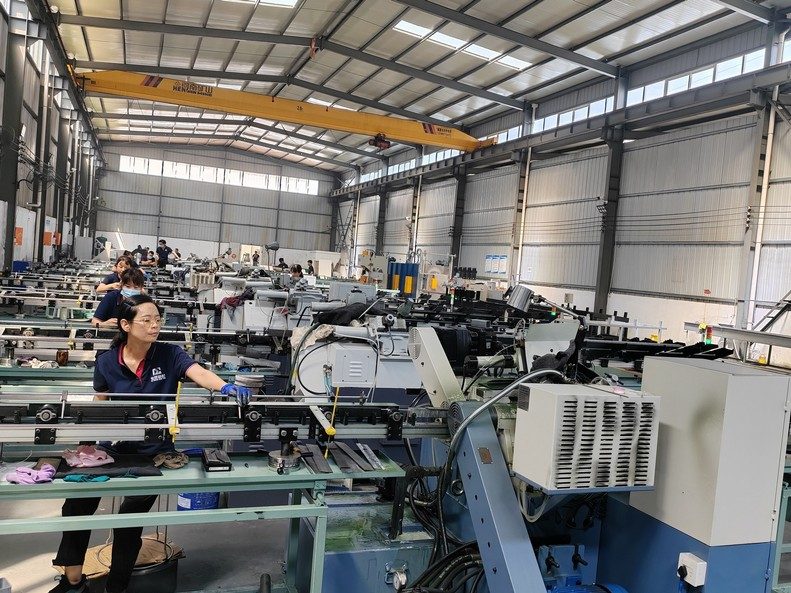
This is where most medical bar orders live, and where finish and tolerance matter as much as the grade. Precision centerless ground bar arrives ready for tight machining without a first cleanup pass. On a medical CP bar RFQ, state:
- Diameter and tolerance. Medical work commonly calls for tolerances in the ±0.0005 in (±0.0127 mm) range. Beiyu holds ±0.0005 in (±0.0127 mm) on centerless ground CP bar, reviewed per diameter before quoting.
- Surface finish. A common call-out is 32 RMS (≈0.8 µm) or better on the ground surface.
- Condition. State the required delivery condition, such as annealed, and confirm it against the ordered specification and drawing.
- End preparation. Chamfers (for example 3/32 in × 45°) and straightness limits are frequently specified for bar feeding into automatics.
- Length. Fixed-length ranges are common; state the length window on the RFQ.
What metallurgical limits should be on the RFQ?
For implant-grade CP bar, two requirements beyond the grade decide acceptance, and buyers should state them explicitly rather than assume:
- Grain size. An ASTM E112 grain-size number is often required and recorded on the certificate (values such as ≥5.0 or ≥8.0 appear on medical drawings).
- Hydrogen content. A maximum hydrogen limit is a standard implant control; medical drawings frequently cap it (for example ≤0.0125%).
Both are checked at the mill and reported by heat number, so they belong in the certificate package, not just the purchase order.
For a deeper RFQ checklist, see Beiyu’s guide to grain size and hydrogen control on medical titanium bar.
When do you move from F67 CP to F136 ELI alloy?
ASTM F67 covers commercially pure titanium; ASTM F136, extra-low-interstitial (ELI) Ti-6Al-4V (UNS R56401), covers a different alloy. The device manufacturer selects the material against the design, required properties and validation requirements. Bone contact or load alone does not determine the specification. Beiyu supplies both F67 CP bar and F136 ELI Ti-6Al-4V bar, with the appropriate material route and documentation confirmed for each order.
What documentation should the bar ship with?
Medical buyers qualify the paper trail as strictly as the metal. Beiyu supplies CP titanium bar with:
- EN 10204 3.1 mill test certificates covering chemistry and mechanical properties.
- Heat-number traceability back to the melt.
- Grain size and hydrogen results: hydrogen results are part of the required chemistry records; grain-size reporting and any tighter hydrogen limit follow the ordered specification and drawing.
For medical scope, material can be sourced from mills operating certified ISO 13485 systems, and the producing mill’s quality certificates accompany the material per order, so the certificate entity always matches the mill on the MTC.
How to read the F67 mill certificate when it arrives
Check the following fields when checking the certificate against what you ordered. They support the review but do not replace the complete requirements of the ordered F67 edition and drawing.
| Line on the certificate | What to check | Why it decides acceptance |
|---|---|---|
| Oxygen | That the reported value matches the grade on your order, not just the grade name | Oxygen is what separates CP Grades 1 to 4. A Grade 2 bar near the top of its band is stronger and less ductile than one near the bottom |
| Hydrogen | That an actual result is reported and inside the limit, not left blank | F67 caps hydrogen because it drives embrittlement risk in service |
| Mechanical values | Read them against the ordered size and condition, not the headline minimum | Minimums are met at the test location; larger diameters can sit lower in the band |
| Grain size | Present only if your order asked for it | F67-13(2017) does not specify a numerical grain-size limit; check the ordered edition and drawing for the required scope |
| Heat number | Must match the stamp or tag on the bar bundle | Closes the traceability loop between paper and metal |
Then close the loop on traceability: the heat number on the certificate must match the stamp or tag on the bar bundle. The common trap is treating the phrase medical grade as proof; it is not. The certificate has to name ASTM F67 and the CP grade and report the interstitial results, because a plain B348 or B265 certificate, even with identical chemistry, has not been certified to the implant specification and is not implant-qualified material.
The oxygen ladder: how one interstitial sets four grades apart
The table compares oxygen limits and annealed tensile minimums from F67-13(2017), Tables 1 and 3. Grade selection also requires the other chemistry limits and mechanical requirements; oxygen alone does not establish compliance.
| F67 grade | Oxygen max | Minimum tensile | Character |
|---|---|---|---|
| Grade 1 | 0.18 percent | 240 MPa | Softest and most formable |
| Grade 2 | 0.25 percent | 345 MPa | The general-purpose CP grade |
| Grade 3 | 0.35 percent | 450 MPa | Higher annealed tensile minimum than Grade 2 |
| Grade 4 | 0.40 percent | 550 MPa | Strongest and least forgiving |
On the certificate this shows up as the oxygen row carrying most of the weight the alloy table carries for alloyed grades, with iron as the second discriminator and the mechanical minimums still to be met in their own right. A CP certificate with a vague or missing oxygen value is not a usable document for grade verification. The full selection logic across the four grades is in the CP titanium grade selection guide.
Microstructure and grain size in CP bar
CP titanium is a single-phase alpha metal at room temperature, so its microstructure story is simpler than the alpha-beta alloys: the working variables are grain size and the uniformity of the worked structure. Finer, uniform equiaxed grains give better strength-ductility balance and more consistent machining behaviour; coarse or mixed grain structures behave less predictably in forming and polishing. Where a drawing cites a grain size requirement, put it on the order so it is tested and reported rather than assumed. How grain size is measured and reported on medical bar, and why hydrogen is controlled alongside it, is covered in the grain size and hydrogen control guide.
Machining CP titanium: gummier than the alloy, kinder than its reputation
CP titanium machines differently from Ti-6Al-4V. It is softer and gummier, more prone to built-up edge and smearing than to tool-edge chipping. The working answers are sharp tools, steady positive feed, good coolant flow and no dwelling, because a rubbing tool smears the surface and drags the finish. For medical bar destined for Swiss machining, the practical procurement consequences are the same as for the alloy: hold the diameter tolerance and straightness the machine needs, and keep finishing passes cutting cleanly, since the machined surface carries the part’s fatigue and finish quality. The general titanium machining behaviour, including galling mechanics, is covered in the Ti-6Al-4V galling and work-hardening guide; CP is the gentler case of the same family rules.
Handling, identity and the medical chain
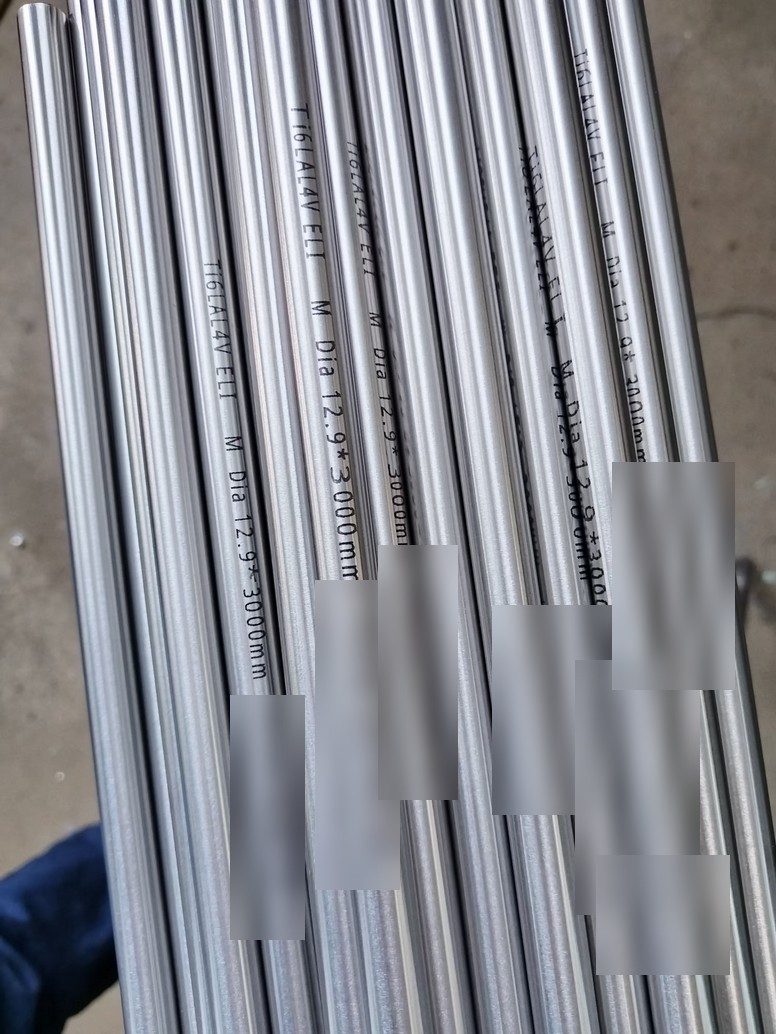
Every bar carries its own identity. This photograph shows TI6AL4V ELI bar, not F67 commercially pure titanium. It illustrates grade, condition, size and heat identification only; it does not establish F67 compliance. Match the marking on the supplied CP bar to its own certificate.
The heat number is masked here on purpose. It is a reverse lookup key, so it does not belong on a public page. It appears in full on the bar itself and on the EN 10204 3.1 certificate that ships with it.
The handling rules for CP medical bar are the same as for ELI, and they protect the same two assets: surface and identity. Store titanium away from carbon steel so embedded iron does not stain the surface or fail a surface-iron check; keep heats separated and marked; keep the certificate with the material. A CP bar that loses its heat identity has lost its medical-chain standing even though the metal is unchanged. The complete ordering discipline, line by line from specification to packing, is in the medical titanium bar RFQ checklist.
Limitations: where CP stops and the alloy starts
| Where CP stops | Why | What to do instead |
|---|---|---|
| Strength has a ceiling | Even Grade 4 sits far below Ti-6Al-4V on the specification minimums | Compare candidate materials, conditions and properties against the device design and validation requirements. A component name alone does not establish that CP titanium or an ELI alloy is suitable. |
| Softness shows in service | CP surfaces scratch and gall more readily than the alloy | Sliding interfaces and threaded titanium-on-titanium joints need design-side answers |
| Oxygen is a one-way door at the mill | The grade’s oxygen level is set in melting and cannot be re-graded downward later | The grade on the order is the grade you own. Decide it before the heat, not after |
| It qualifies material, not devices | F67 bar is implant-grade input stock | Biocompatibility, design and approval of the finished device belong to the device maker’s file |
Frequently asked questions
Is ASTM F67 the same as Grade 2 titanium?
No. ASTM F67 is the surgical-implant specification for commercially pure titanium and covers Grades 1 through 4. Grade 2 is one CP grade within F67, and the most commonly ordered.
Can F67 bar be supplied precision ground?
Yes. Beiyu supplies precision centerless ground CP titanium bar to the agreed diameter tolerance and surface finish. Specify the F67 edition and confirm any B348 dual-certification requirement separately.
What is the difference between ASTM F67 and ASTM F136?
F67 covers commercially pure titanium (Grades 1-4). F136 covers ELI Ti-6Al-4V alloy (UNS R56401). Selection depends on the device design, required properties and validation requirements, not bone contact or load alone.
What certificates come with medical CP titanium bar?
EN 10204 3.1 mill test certificates with heat-number traceability and the required chemical and mechanical results, including hydrogen. Confirm grain-size reporting and any tighter hydrogen limit against the ordered specification and drawing.
References
- ASTM F67, Standard Specification for Unalloyed Titanium for Surgical Implant Applications: astm.org/f0067
- ASTM B348, Standard Specification for Titanium and Titanium Alloy Bars and Billets: astm.org/b0348
- ISO 5832-2, Implants for surgery, metallic materials, unalloyed titanium: iso.org/standard/69907
- EN 10204, Metallic products, types of inspection documents (CEN)
How much margin a real F67 heat leaves against the limits
The measured values below come from an independent analysis of upper and lower ingot-chip samples from one documented Beiyu CP Grade 2 heat, using ASTM E1409, E1447, E1941 and E2371 methods. They are sample results, not finished-bar test results or evidence of whole-heat uniformity. For comparison, the limits shown are from F67-13(2017), Table 1; this reference edition is not an attribution of the laboratory report’s edition. Percentages use the higher measured value where a range is shown, rounded to a whole percent.
| Element, w/percent | Measured | F67-13(2017) Grade 2 finished-bar reference maximum | Allowance used |
|---|---|---|---|
| Hydrogen | 0.0006 | 0.015 | 4 percent |
| Carbon | 0.012 to 0.013 | 0.08 | 16 percent |
| Nitrogen | 0.005 | 0.03 | 17 percent |
| Iron | 0.051 to 0.059 | 0.30 | 20 percent |
| Oxygen | 0.116 | 0.25 | 46 percent |
Percentages compare ingot-chip samples with historical finished-bar limits; they establish neither ingot acceptance nor finished-bar compliance. F67-13(2017), Section 7.1, requires hydrogen samples from the final mill product. Review the supplied material’s own EN 10204 3.1 records and required tests. F67 and ISO 5832-2 require separate conformance review; F136 covers the ELI alloy, not the same CP bar.
What melting and inspection Beiyu puts behind medical CP bar
Oxygen is one controlled constituent, not the complete acceptance basis. Review all required chemistry and mechanical results for the specified grade, condition and product form. Being below an oxygen maximum alone does not make a heat compliant.
Beiyu Titanium melts medical and implant-chain material three times under vacuum, and ultrasonic inspection is standard on the mill products that come from it. That combination is aimed at the two things a CP implant order can not recover from later: interstitial pickup set at the melt, and internal discontinuities that only show under sound. The route is tied to the heat number on the EN 10204 3.1 certificate, so both the melt count and the inspection scope are checkable against the specific heat rather than assumed from the grade name.
Which inspections run on every bar, and which run on a sample
Beiyu’s documented precision ground bar route, diameter 3.175 to 25.4 mm, includes the five checks below at 100 percent coverage. Chemistry and tensile results are obtained from samples. The checks and ultrasonic settings describe this documented route; other sizes and product forms require their own agreed inspection scope.
| Inspection run at 100 percent | What it is there to catch |
|---|---|
| Ultrasonic flaw detection | Internal discontinuities: inclusions, porosity and laps carried forward from the billet |
| Eddy current flaw detection | Surface and near surface defects, which ultrasound resolves poorly close to the skin |
| Surface optical inspection | Grinding marks, scratches and handling damage on the finished surface |
| Infrared laser diameter measurement | Diameter along the whole length rather than at the ends only |
| Straightness measurement | Bow over length, which affects feeding stability in automatic and sliding head machining |
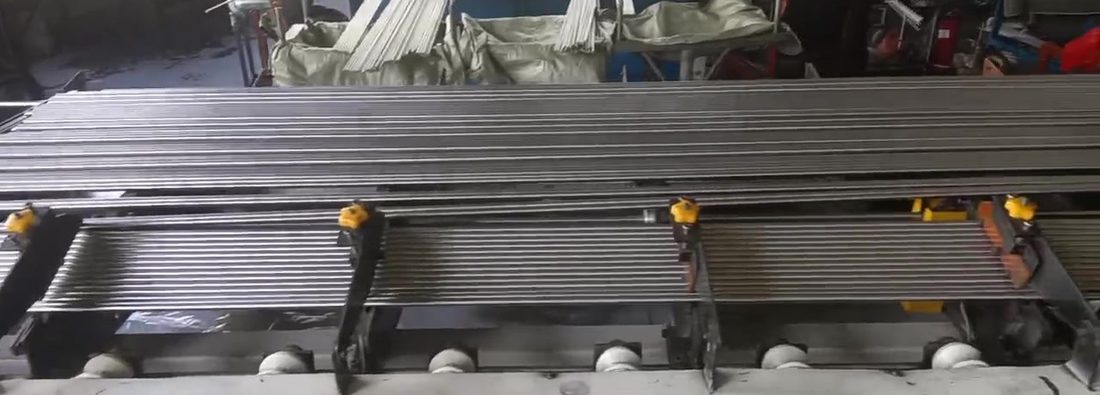
The last two lines matter more than they look on a medical order. A bar that is inside diameter tolerance at both ends can still be outside it in the middle, and a bar that measures straight on a surface plate can still whip in a collet. Measuring both along the full length is what turns a diameter tolerance into something a machine shop can actually hold.
The ultrasonic setting behind the words “ultrasonic tested”
| Ultrasonic parameter | Documented setting on the precision ground bar route |
|---|---|
| Method | Water immersion, focused longitudinal wave |
| Coverage | 100 percent of the circumference |
| Calibration reflector | Φ1.2 mm radial flat bottom hole, set to 80 percent screen height |
| Probe frequency | 10 MHz |
| Acceptance class | A1 |
| Acceptance specification | AMS-STD-2154 or GB/T 5193, whichever the order calls for |
Confirm these settings against the ordered F67 edition. F67-13(2017), Section 10.3, requires final-diameter testing to AMS 2631 Class A1 for centerless ground or peeled and polished round bar nominally 9.5 mm (0.375 in) and larger, with equivalent methods agreed by purchaser and supplier. The catalogue settings above do not by themselves establish equivalence. A flat-bottom hole is a calibration target, not a guarantee that every discontinuity of that size will be detected.
The precision ground bar envelope
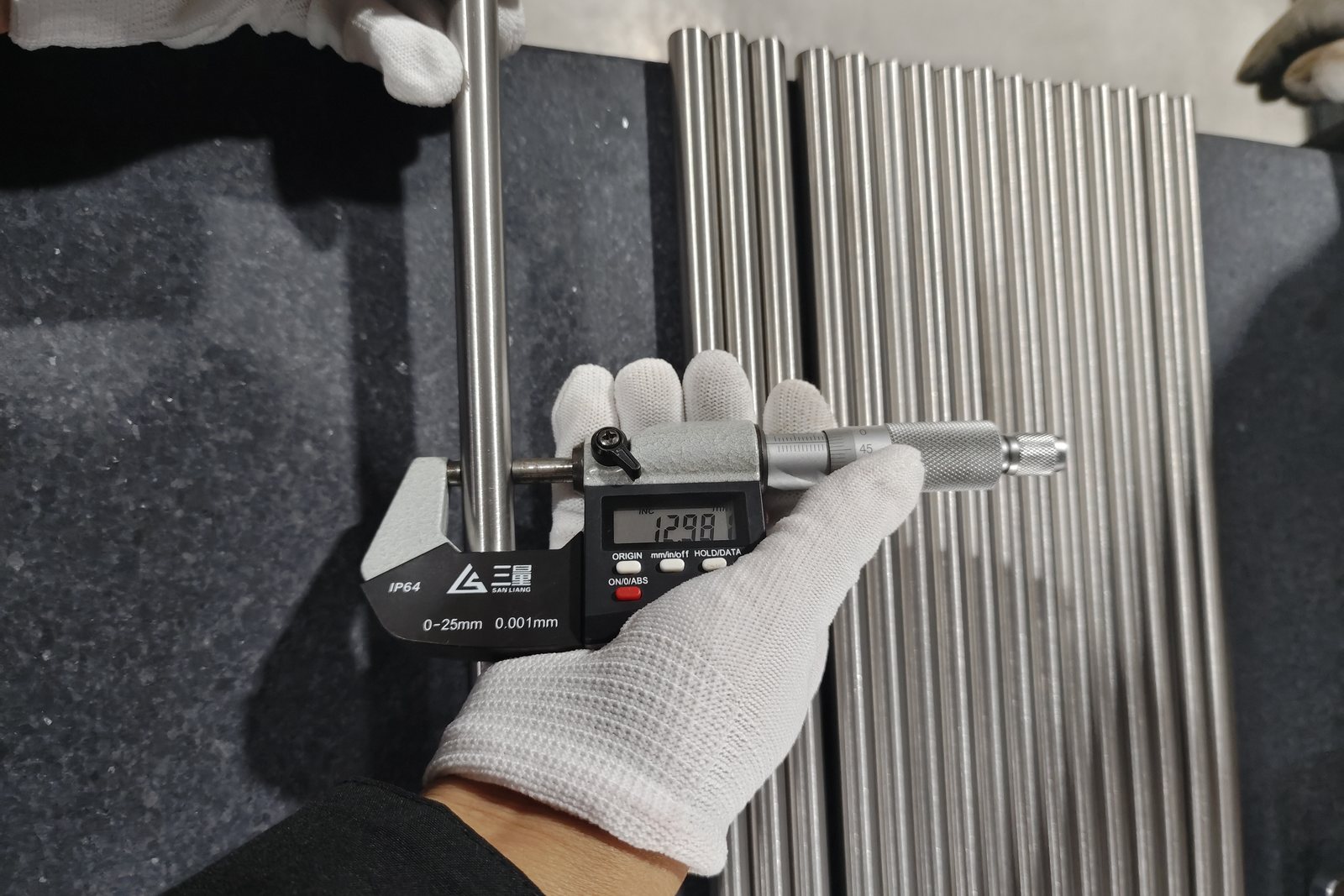
| Parameter | Beiyu supply envelope for medical ground bar |
|---|---|
| Diameter range | Ø3.175 mm to Ø25.4 mm (0.125 in to 1.000 in) |
| Standard diameter tolerance | ±0.0127 mm (±0.0005 in) |
| Tightened tolerance | ±0.0076 mm (±0.0003 in), by agreement at enquiry |
| Surface | Polished, 32 microinch RMS as specified |
| Grain size | ASTM E112 ≥5.0 or ≥8.0, by order |
| Hydrogen control | ≤0.0034 wt% by order; compare with the applicable finished-bar limit in the ordered F67 edition |
| Standards | CP titanium: ASTM F67; Ti-6Al-4V ELI: ASTM F136; Ti-6Al-4V: ASTM F1472. Separate material routes, confirmed by order. |
The tightened tolerance and the hydrogen figure are both worth agreeing at enquiry rather than after the order, and both should be verified on the finished bar. Hydrogen can be lowered by a qualified vacuum treatment route, but acceptance rests on the measured result for the material supplied, not on the intent.
Specification detail with sources
The historical tables linked above separate chemistry limits from mechanical minimums. Check nitrogen, carbon, hydrogen and iron as well as oxygen. Iron is not an interstitial element.
The strength figures above are specification minimums for the identified annealed condition, not patient-specific design allowables or results for a particular shipment. Check the ordered edition and supplied material records; the device manufacturer remains responsible for material selection and device validation.
Request a quote for ASTM F67 titanium bar
Before sending the drawing, check the order line against the titanium bar RFQ checklist so the dimensional, tolerance, condition and certificate fields arrive together.
To quote medical-grade CP titanium bar, Beiyu needs: grade (CP 1/2/3/4), diameter and tolerance, length, surface finish, condition, and any grain-size, hydrogen or end-preparation requirements. Send the drawing or spec and we review each line against grind and metallurgical capability before quoting, with EN 10204 3.1 MTC and heat-number traceability by order scope. Contact Beiyu Titanium for an RFQ.
Related Beiyu resources
- ASTM F136 Ti-6Al-4V ELI Bar Guide
- Grade 2 Titanium Bar | ASTM B348 Commercially Pure Titanium
- ASTM B348 Titanium Bar & Billet Guide
- Titanium Materials for Medical Industry
- Medical-Grade Titanium: ASTM F136, F67 and Grade 23 ELI Explained
Reference sources
- ASTM F67, Standard Specification for Unalloyed Titanium, for Surgical Implant Applications (UNS R50250, R50400, R50550, R50700)
- ASTM B348 / B348M, Standard Specification for Titanium and Titanium Alloy Bars and Billets
- ISO 5832-2, Implants for surgery, Metallic materials, Part 2: Unalloyed titanium
- ASTM E112, Standard Test Methods for Determining Average Grain Size
- EN 10204, Metallic Products, Types of Inspection Documents